
Home / Boating Safety Manual / Day Beacons Found on Canada’s Waterways
10% OFF WITH CODE:
BLACKFRIDAY10

Day beacons are fixed navigational markers that provide important navigation information to boaters. Before navigating a channel, you should be familiar with the common types of day beacons and understand their meaning and significance. It’s key to safe navigation.
Key takeaways
- Day beacons on Canada’s waterways indicate the preferred channel to boaters navigating upstream.
- Depending on the colour and shape of the day beacon, boat operators must keep to the port or starboard.
- Common day beacons include: port-hand day beacons, starboard-hand day beacons, starboard junction (bifurcation) day beacons and port junction (bifurcation) day beacons.
Table of contents
- Day beacon: definition
- Difference between beacons and buoys
- Day beacons: function and uses
- 4 Common types of day beacons
- 1. Starboard-Hand Day Beacon
- 2. Port-Hand Day Beacon
- 3. Starboard Junction (Bifurcation) Day Beacon
- 4. Port Junction (Bifurcation) Day Beacon
- Ranges
- Frequently Asked Questions
Day beacon: definition
A day beacon is a specific type of unlighted sign or “marine aid to navigation” (ATON) used to help boaters determine their position and course during daylight hours only.
The beacon consists of a highly visible signboard or panel called a daymark, which uses specific colors and geometric shapes for quick identification. These shapes and colors correspond to the lateral or cardinal systems of navigation.
Difference between beacons and buoys
Both buoys and beacons fall under the general category of Aids to Navigation (ATON), which act as “traffic signs” on the water to guide mariners, mark channels, and warn of hazards.
- A day beacon is a rigid structure permanently fixed to the seabed, land, or on a pole (a pile or skeleton framework). This makes it a very stable and reliable reference point.
- A buoy is a floating marker.
Day beacons: function and uses
Beacons (and buoys) serve three main functions:
- Mark the edges of safe navigable channels, so that boaters can follow the correct right-of-way rules depending on whether they are travelling upstream or downstream and avoid collisions.
- Indicate hazards like rocks, shoals, or wrecks.
- Designate special areas (e.g., anchorage zones, restricted areas, diving activities, swimming activities).
4 Common types of day beacons
There are four main types of day beacons: starboard hand, port hand, starboard junction (bifurcation) and port junction (bifurcation) day beacons.
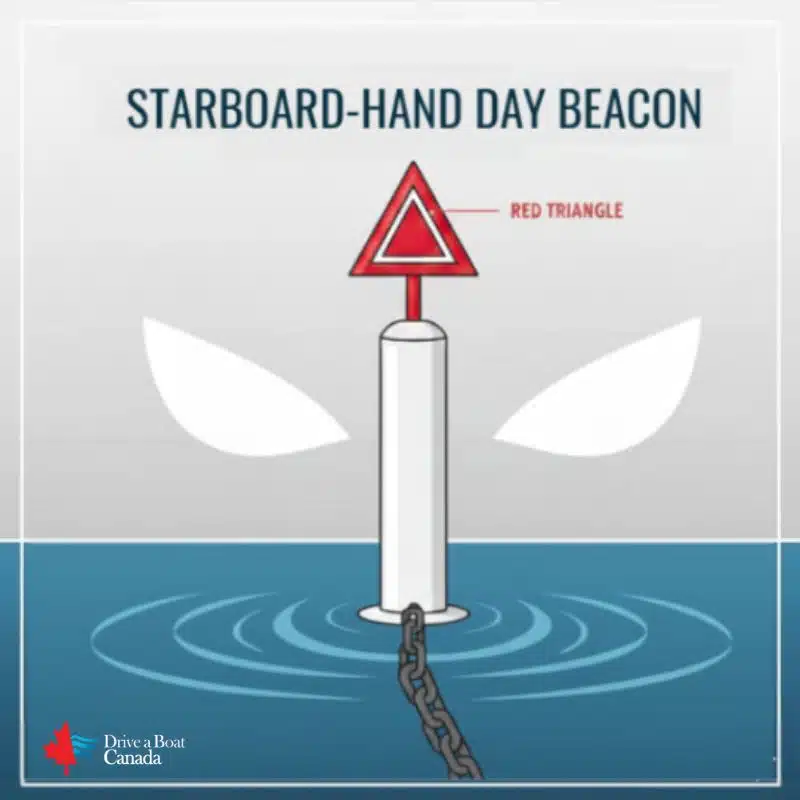
1. Starboard-Hand Day Beacon
A starboard-hand day beacon clearly indicates the right-hand boundary of a channel when a vessel is travelling upstream.
- Features a red triangle centered on a white background with a red trim.
- Keep this beacon on your starboard (right) side when navigating upstream.
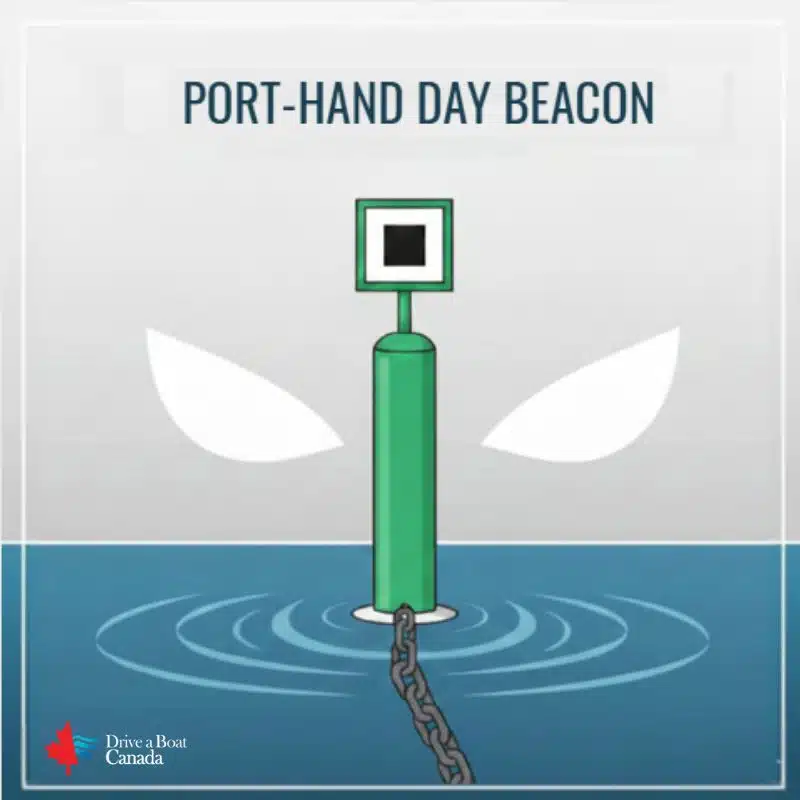
2. Port-Hand Day Beacon
A port-hand day beacon clearly indicates the left-hand boundary of a channel when a vessel is travelling upstream.
- Features a black square centered on a white background with a green trim.
- Keep this beacon on your port (left) side when navigating upstream.
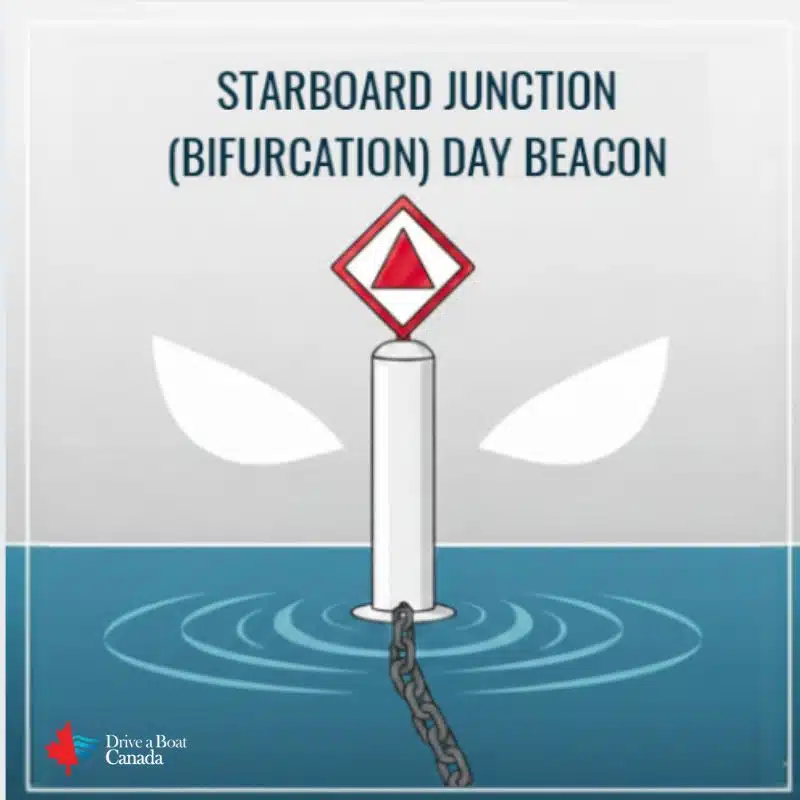
3. Starboard Junction (Bifurcation) Day Beacon
A starboard junction day beacon also marks a channel division (bifurcation). It shows that the preferred (or main) channel is to the port (left) of the beacon.
- Features a red triangle on a white background with a red trim. Or, shows both red and green in some other format, with red dominant.
- You can choose whether to pass this beacon on the right or left (treat it as either a port-hand or starboard-hand mark). The preferred channel is to the port (left) of the beacon. If you choose the preferred channel, keep the beacon on your starboard (right) side.
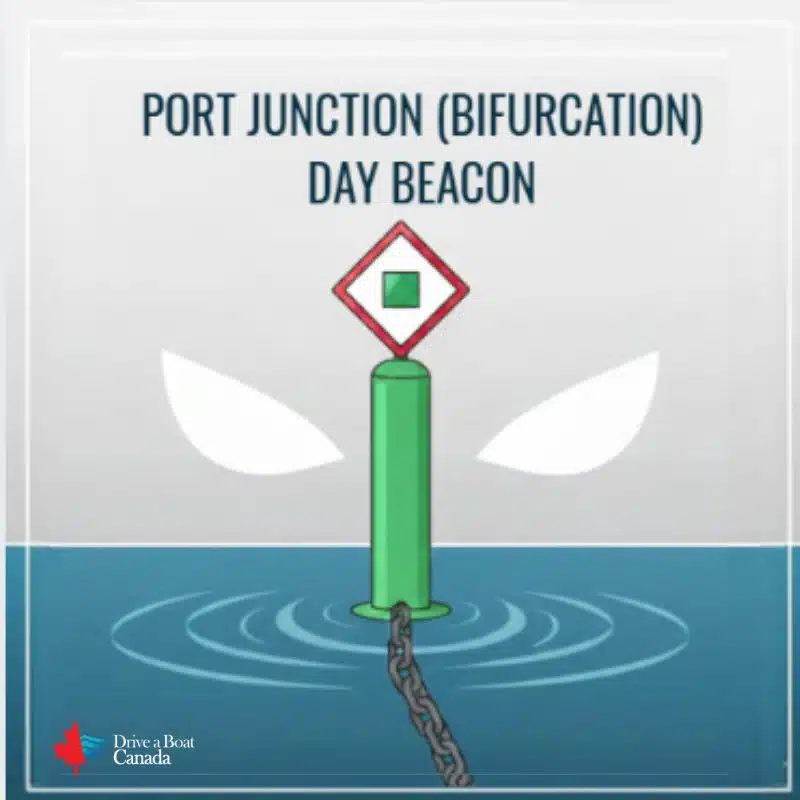
4. Port Junction (Bifurcation) Day Beacon
A port junction day beacon marks a point where the channel divides (bifurcates). It shows that the preferred (or main) channel is to the starboard (right) of the beacon when travelling upstream.
- Features a green square with a red, diamond-shaped rim. Or, shows both colours in some other format, with green dominant.
- You can choose whether to pass this beacon on the right or left (treat it as either a port-hand or starboard-hand mark). The preferred channel is to the starboard (right) of the beacon. If you choose the preferred channel, keep the beacon on your port (left) side.
Ranges
Ranges are a series of navigational markers that boaters can use to maintain their position within a channel or waterway. While a single day beacon marks a specific spot or boundary, a range provides a continuous, highly reliable visual line to follow.
A range marks the center line of a narrow channel, harbor entrance, or river course and provides one of the most accurate lines of position (LOPs) available in coastal and inland navigation.
Ranges consist of two or more day beacons that are aligned. They allow a boat operator to maintain a straight course with high precision, compensating for current, wind, and steering errors.
When boaters align the day beacons, they can determine if they are on course and maintain their position within the channel. Ranges are typically found in narrow channels or in areas with strong currents.
Get your boating licence with Drive A Boat Canada!
We offer a comprehensive online course leading to lifetime certification. Register with Drive a Boat Canada today, and learn everything you need to know to pass the boating exam. With your boating licence (PCOC), you can take to the water legally anywhere in the country.
Frequently Asked Questions
“Upstream” is the direction a vessel travels when proceeding from seaward toward the headwaters of a river, or when entering a harbour from the sea, usually against the current.
The mnemonic “Red Right Returning” is commonly used: When Returning (traveling Upstream) from the sea or open water, keep the Red (Starboard-Hand) markers on your Right (Starboard) side.
Conversely, you keep the Green (Port-Hand) markers on your Left (Port) side when heading upstream.
No. Day beacons are unlighted and are explicitly intended for daytime use only. While they may have reflective borders or letters for chart identification, they do not provide navigational guidance at night. For nighttime navigation, mariners must rely on lighted buoys, major lighted aids, and electronic navigation.
Cardinal day beacons indicate the direction of the deepest and safest water (North, East, South, or West) relative to the marker. They are less common than lateral markers.
Sources
- Transport Canada. Transport Canada Lateral Buoys and Standard Daybeacons [PDF]. Office of Boating Safety. https://tc.canada.ca/sites/default/files/migrated/tp14541ef_en.pdf
Latest articles

Is Your Boat a Pleasure Craft? Know the Law to Avoid Fines
A pleasure craft (whether it’s a canoe, kayak, motorboat or sailboat) is a boat that is used exclusively for recreational boating. Getting your Pleasure Craft Operator Card allows you to legally operate a pleasure craft anywhere in Canada where motorized vessels are permitted. However, it does not allow you to use your vessel for commercial Read more ›

All About Canada’s New Life Jacket Labels
Canada recently transitioned to new life jacket labels, and many boaters are wondering which life jackets they can use for recreational boating activities. You may also be asking whether you can use your old life jacket, what the icons on the new labels mean, and whether the same boating safety equipment rules still apply. Here Read more ›

Rules for Naming or Renaming a Boat in Canada
A boat’s name often reflects the entire journey that led to buying your own pleasure craft. Whether it represents a hard-earned retirement, a tribute to a loved one, or a symbol of freedom, putting that name on the hull is a special moment. In Canada, there are a few rules you need to follow for Read more ›