
Home / Boating Safety Manual / Radar Reflectors on Boats: Requirements and Installation
10% OFF WITH CODE:
BLACKFRIDAY10

Radar reflectors make small, non-metallic boats visible to the radar of larger ships. It is a required piece of boating safety equipment as it can help prevent large and small vessels from colliding on the water, particularly in adverse conditions.
Key takeaways
- Radar reflectors help small vessels get noticed.
- They reflect radar back to other vessels, which means their size, location and speed can be tracked.
- Radar reflectors are required on boats less than 20 m long or made primarily of non-metallic materials.
- They may not be required if you are operating in an area with light traffic, during the day and in favourable weather conditions.
- Passive radar reflectors should be mounted at least 4 m from the waterline.
- There are several shapes to choose from, depending on a variety of factors.
Table of contents
- What is a radar reflector?
- What is radar?
- Why some boats need radar reflectors
- Radar reflector requirements on boats
- Best place to install a radar reflector
- Frequently Asked Questions
What is a radar reflector?
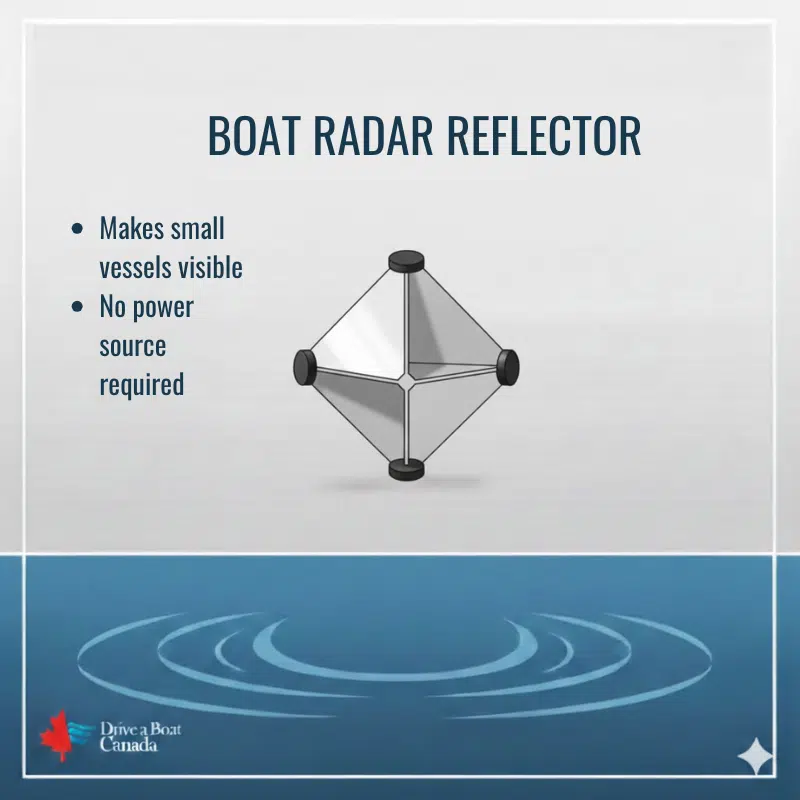
A radar reflector is a device that can be attached to a boat to make it more visible on radar. It is made up of multiple pieces of metal that intersect to form a geometric shape that creates a strong reflection on radar.
What is radar?
Radar uses radio waves to detect objects, and determine how far away they are, which direction they are heading, and the speed of their movement. The waves are sent out, reflected by objects in their path, and used to create images, even in poor visibility.
Why some boats need radar reflectors
Small vessels can be difficult to detect on the water, both visually and by radar.
They can be barely visible to the naked eye from a distance, particularly from the bridge of a larger vessel. In rough weather, they can be completely obscured by fog, spray or swells.
If your boat is small, sits low in the water or is made of wood or fiberglass, you could also be difficult to spot on radar.
If you are caught boating in restricted visibility, radar is often one of the only ways you can be identified by other boats, and that’s why you need a radar reflector. If you are invisible, even on a radar screen, you are in danger of being struck. If you have a radar reflector, you have a better opportunity to be noticed.
Radar reflector requirements on boats
It’s vital to have a properly positioned radar reflector so that larger vessels are able to detect your presence and avoid collisions.
According to the Collision Regulations, pleasure crafts that are less than 20 m long or made primarily of non-metallic materials (fiberglass, wood, plastic, etc.) must be equipped with a passive radar reflector.
However, there are exceptions—a radar reflector is not required if the craft is operating in areas with light traffic, during the day and in favourable weather conditions.
Furthermore, if a radar reflector is not essential to the safety of the vessel or its small size makes it impractical to mount, it is not required.
Best place to install a radar reflector
A radar reflector must be mounted or suspended at least 4 m above the waterline in order to be effective. The reflector’s size also has a major impact on its effectiveness—generally speaking, the bigger it is, the better.
If you use the common octahedral metal plate reflector, it should be mounted in the “catch rain position”, with one corner cavity pointing straight up. This way, radar waves hitting it from any horizontal angle are bounced directly back to the source.
Get your boating licence with Drive A Boat Canada!
We offer a comprehensive online course leading to lifetime certification. Register with Drive a Boat Canada today, and learn everything you need to know to pass the boating exam. With your boating licence (PCOC), you can take to the water legally anywhere in the country.
Frequently Asked Questions
Passive reflectors are the most common and are what the Canadian regulations specifically call for. They are metal shapes that physically bounce radar waves back. They are cheap, require no power, and are the standard for most pleasure craft.
Active Reflectors are electronic devices that receive a radar signal, amplify it, and flash it back. They are not specifically mentioned in Canadian law.
There are three shapes to choose from for your passive radar reflector:
- The Octahedral: This is a classic shape made of three intersecting metal plates (circles or squares) at 90° angles. When a radar wave hits one of these pockets, it bounces off all three surfaces and returns exactly where it came from. Most popular choice.
- The Tri-Lens / Luneberg Lens: These are typically cylindrical or spherical and look like a solid tube or ball. Instead of just using flat plates, they use specialized lenses or a complex array of internal corners to focus the radar energy. They maintain a strong reflection at almost any angle. Highly effective.
- The Tubular Reflector: These are long, thin tubes often seen on the shrouds of sailboats. They are aerodynamic and don’t catch the wind, but are considered the least effective shape. Least effective.
Sources
- Government of Canada International Regulations for Preventing Collisions at Sea, 1972 with Canadian Modifications Department of Justice. https://laws-lois.justice.gc.ca/eng/regulations/c.r.c.,_c._1416/page-2.html?wbdisable=true
- Transport Canada. SAFE BOATING GUIDE. [PDF]. https://tc.canada.ca/sites/default/files/2024-03/tp_511e.pdf
Latest articles

Is Your Boat a Pleasure Craft? Know the Law to Avoid Fines
A pleasure craft (whether it’s a canoe, kayak, motorboat or sailboat) is a boat that is used exclusively for recreational boating. Getting your Pleasure Craft Operator Card allows you to legally operate a pleasure craft anywhere in Canada where motorized vessels are permitted. However, it does not allow you to use your vessel for commercial Read more ›

All About Canada’s New Life Jacket Labels
Canada recently transitioned to new life jacket labels, and many boaters are wondering which life jackets they can use for recreational boating activities. You may also be asking whether you can use your old life jacket, what the icons on the new labels mean, and whether the same boating safety equipment rules still apply. Here Read more ›

Rules for Naming or Renaming a Boat in Canada
A boat’s name often reflects the entire journey that led to buying your own pleasure craft. Whether it represents a hard-earned retirement, a tribute to a loved one, or a symbol of freedom, putting that name on the hull is a special moment. In Canada, there are a few rules you need to follow for Read more ›