Home / Boating Safety Manual / Personal Flotation Devices (PFDs) and Lifejackets: Types, Rules & Regulations
10% OFF WITH CODE:
BLACKFRIDAY10
Lifejackets and PFDs save lives. Their job is to keep you afloat if you fall into the water. According to the Canadian Red Cross, wearing a lifejacket could eliminate up to 90% of all drownings that occur while boating. Not wearing a lifejacket or PFD is a major risk factor for recreational boating deaths in Canada.
In order to make boating safer for all Canadians, the government now legally requires vessels to have an appropriately sized personal life saving appliance (lifejacket or PFD) for each person on board. Boat operators need to know which types of lifejackets and PFDs are approved in Canada and be familiar with the rules and regulations governing their use.
Key takeaways
- Canadian law governs the use of appropriate life jackets and PFDs on boats.
- General rules govern approval by marine authorities, expiration date, number of lifejackets or PFDs required on a boat, and labels.
- Old lifejacket labels categorized gear by ‘Type’. New lifejacket labels categorize gear by ‘Level’.
- Lifejackets and PFDs do not have exactly the same function: while lifejackets are foam-filled and designed to turn a wearer face-up in the water, PFDs are lighter and inflatable and not designed to turn the wearer face-up.
- Children cannot wear adult lifejackets or PFDs; they must wear weight-appropriate, approved children’s models.
- Life save appliance care and maintenance is key to keeping your equipment in good working condition. Damaged lifejackets and PFDs lose their approval status and are illegal for use on Canadian waters.
Table of contents
- Lifejacket and PFD Laws in Canada
- Approval by Canadian Authorities
- Expiration date
- One personal life saving appliance per person
- Lifejacket labels
- Lifejacket ‘Types’ and ‘Levels’
- Lifejacket ‘Types’: Approved Uses
- Lifejacket ‘Levels’: Approved Uses
- Lifejackets and PFDs: What’s the Difference?
- Lifejackets
- PFDs
- Life Jackets for Children
- Lifejacket and PFD Care and Maintenance
- When must a personal flotation device (PFD) or lifejacket be replaced?
Lifejacket and PFD Laws in Canada
Approval by Canadian Authorities
The lifejackets and PFDs used while boating in Canada must be approved by:
- Transport Canada
- The Canadian Coast Guard, or
- Fisheries and Oceans Canada.
When purchasing a PFD or lifejacket in Canada, always look for a label that clearly indicates the vest has been approved to be sure that it meets Canadian safety standards. Old labels will show lifejacket ‘Type’ and new labels will show lifejacket ‘Level’ (see below).
Visitors to Canada can use their own lifejacket if it has been approved in their home country and fits properly.
Expiration date
While there is no expiry date for flotation devices, they are no longer considered approved if they are ripped, worn, repaired or altered.
One personal life saving appliance per person
There must be an appropriately-sized lifejacket or PFD for every person on board a vessel, and they must be worn or within reach at all times.
Lifejacket labels
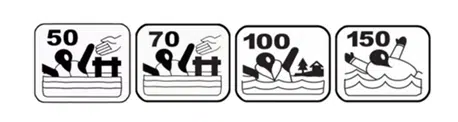
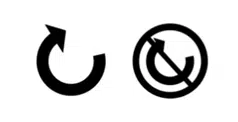
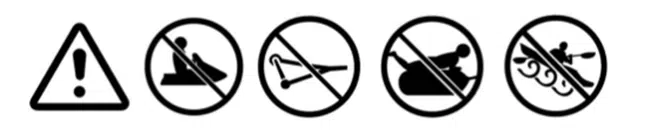
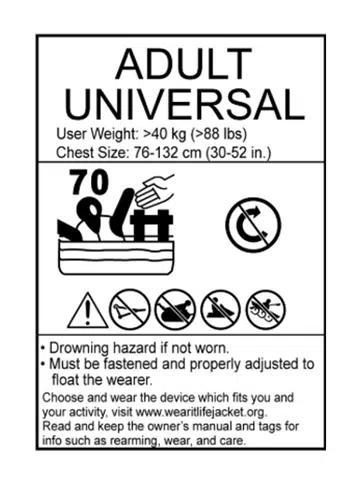
IMPORTANT: Canada has recently harmonized its PFD labeling with international standards, leading to new labels that feature new icons instead of detailed text. These symbols indicate buoyancy, turning ability and suitability for specific activities (like waterskiing) or use with personal watercraft.
You must choose the right type of lifejacket according to your weight and activity.
Example of buoyancy levels
Example of turning capability vs. no turning capability
Example of forbidden activities
Example of complete label
Lifejacket ‘Types’ and ‘Levels’
Lifejackets were previously labelled according to their Type, as follows:
Lifejacket ‘Types’: Approved Uses
| Type I | Offshore Lifejacket | Open ocean, rough seas, or remote water. | Most buoyant. Designed to turn an unconscious person face-up. Bulky but provides the best protection for delayed rescue. |
| Type II | Near-Shore Buoyant Vest | Calm, inland waters where quick rescue is likely. | Classic keyhole shape. Less bulky than Type I. Will turn some unconscious wearers face-up, but not all. |
| Type III | Flotation Aid | Supervised activities (paddling, skiing, fishing). | Most comfortable. Designed for mobility. Does NOT turn unconscious people face-up. Requires the wearer to tilt their head back. |
| Type IV | Throwable Device | All vessels (as a backup). | Not wearable. Ring buoys or cushions meant to be thrown to someone who has fallen overboard. |
| Type V | Special-Use Device | Specific sports (kayaking, windsurfing, commercial rafting). | Activity-specific. Must be used according to the label. Often includes inflatable vests that must be worn to be legal. |
The new labels use ‘Levels’ instead, and categorize jackets by their buoyancy.
Lifejacket ‘Levels’: Approved Uses
| Performance Level | Equivalent ‘Type’ | Best Environment | Key Features & Capability |
|---|---|---|---|
| Level 50 | New Category | Sheltered waters; very close to shore. | Minimal buoyancy. For strong swimmers only. Very slim/mobile. Will not turn you face-up. Must be worn to be legal. |
| Level 70 | Type III | Calm, inland waters; quick rescue likely. | Standard recreational type. Most common for kayaking, SUP, and fishing. Good mobility; will not turn you face-up. |
| Level 100 | Type II | Near-shore; sheltered but open water. | Small vessel lifejacket. Balanced comfort and safety. Designed to turn some unconscious wearers face-up. |
| Level 150 | Type I | Offshore; rough water; remote areas. | Offshore lifejacket. High buoyancy. Designed to turn an unconscious person face-up and keep airways clear. |
| Level 275 | SOLAS / Commercial | Extreme conditions; open ocean. | Industrial strength. For those wearing heavy gear or tools that add weight. |
Lifejackets and PFDs: What’s the Difference?
The terms “lifejacket” and “PFD” are often used interchangeably, but they actually refer to different types of safety devices.
The key differences are:
- A lifejacket provides the most protection and is designed to keep the wearer face-up even if they are unconscious in the water.
- A PFD prioritizes comfort and wearability for active use and will not turn an unconscious wearer face-up.
Lifejackets
Lifejackets are designed to turn the wearer face up in the water so that they can breathe, even if they are unconscious. Most lifejackets are keyhole style, meaning that the floating parts are concentrated around the neck and chest, with only straps in the back. They are extremely buoyant and only come in red, orange and yellow for the sake of visibility.
Lifejackets are made of foam and are inherently buoyant.
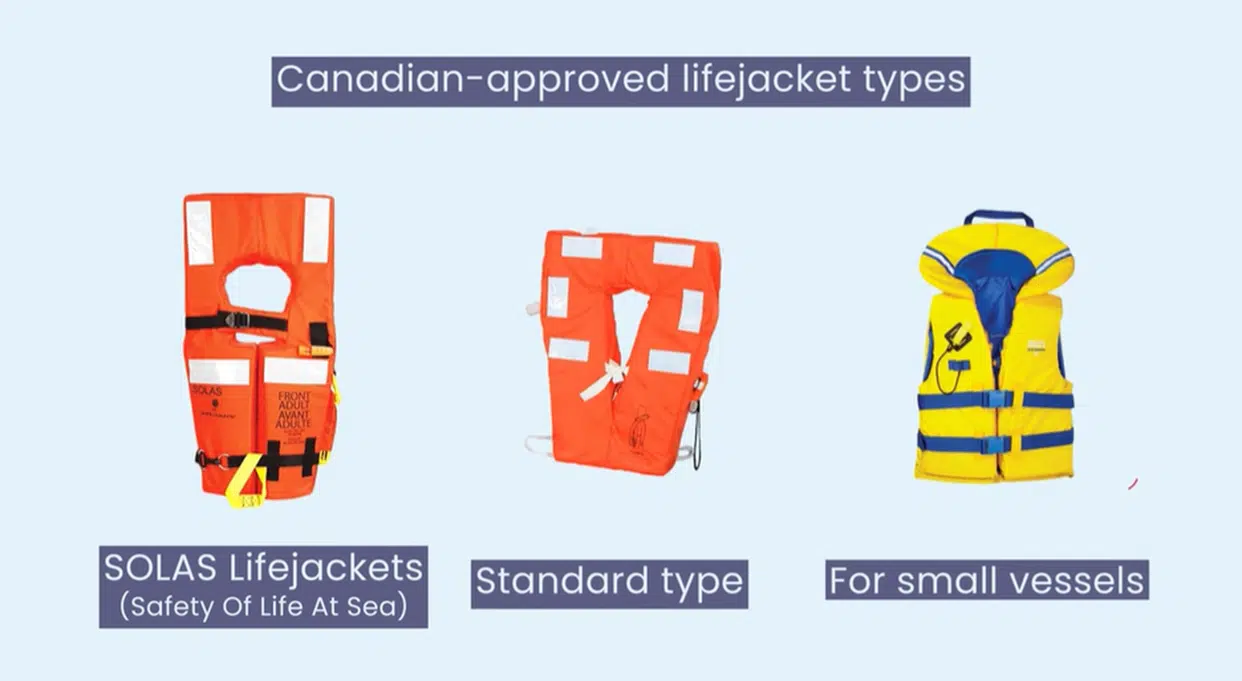
There are three types of Canadian-approved lifejackets:
- Safety of Life at Sea (SOLAS) lifejackets are approved for all types of vessels. They are designed to meet very high standards of performance and are available in both foam and inflatable models. They will turn you on your back in seconds if you are unconscious. Available in 2 sizes: over 32kg (70lbs) and less than 32kg (70lbs).
- Standard lifejackets are approved for all vessels except SOLAS vessels (which are governed by the International Convention for the Safety of Life at Sea). Their performance is not quite as high, but they will turn you on your back even if you are unconscious. Available in 2 sizes: over 40kg (88lbs) and less than 40kg (88lbs)
- Small vessel lifejackets are approved for small vessels only. They are less buoyant than standard lifejackets. They are still designed to turn the wearer face up, but may do so more slowly than the types listed above. They come in both vest and keyhole styles. Available in 3 sizes: over 41 kg (90 lbs), 18 (40) to 41 kg (90lbs) and less than 18 kg (40lbs)
PFDs
There are several types of PFDS:
- Standard adult PFD
- PFD work suit
- Infant PFD, for infants weighing 9 kg (20 lbs) or more
- PFD designed especially for paddle sports
- Inflatable PFDs.
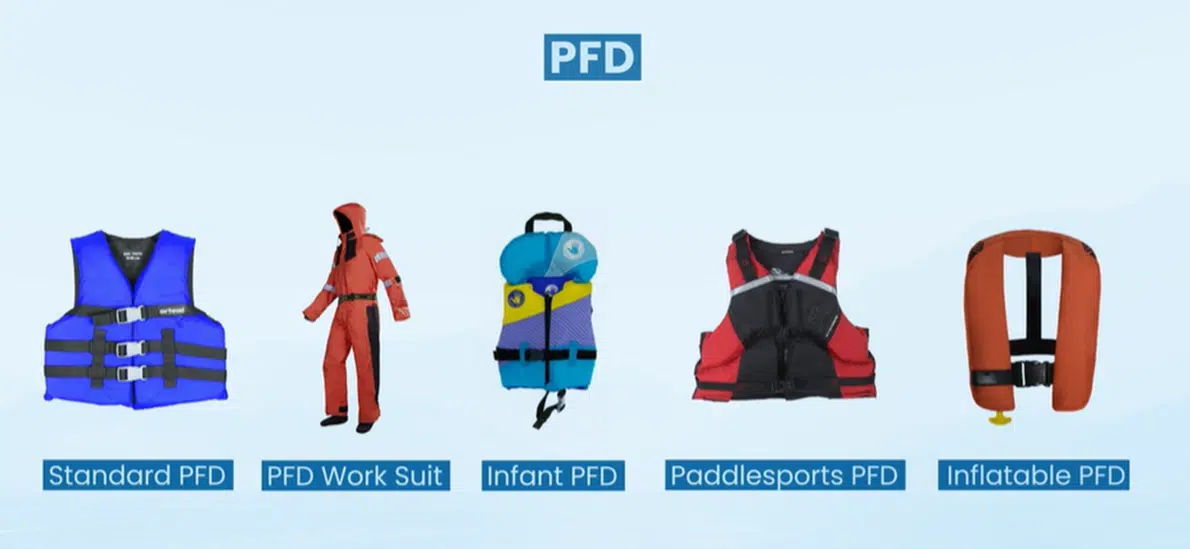
Personal flotation devices are designed for recreational boating, paddling and water sports. They tend to be more comfortable and less bulky than lifejackets, but provide less buoyancy and will not turn the wearer face up. They are available in a wide variety of styles and colours.
There are models of PFDs that are designed for specific activities, such as fishing and paddleboarding. When buying a PFD, make sure to choose a model that is appropriate for the activity you’re planning to use it for. Read the user guide and try it out before leaving so you are familiar with how it works.
Inflatable PFDs
Inflatable PFDs either inflate automatically when they hit the water or can be manually or orally inflated by the wearer. Many devices are equipped with multiple inflation methods in case one ends up being faulty. Most use a carbon dioxide cartridge to inflate.
Important: Inflatable flotation devices are not allowed for children under 16 years of age, anyone weighing less than 36.3 KG (80 lbs), use on a PWC, white-water paddling activities. They must be worn on an open boat, or on deck or in cockpit if you are not on an open boat.
Life Jackets for Children
There are lifejackets and PFDs that are designed specifically for children. The appropriate size is determined based on the child’s weight. The device should be a snug but comfortable fit. If it rides up over the child’s head, it is too big.
Children’s flotation devices should have a large collar to support their head and a safety strap that goes between their legs to prevent the device from slipping off.
Note that in Canada, there are no approved flotation devices for children under 20 pounds. Transport Canada recommends waiting until children are over 20 pounds before taking them boating.
Lifejacket and PFD Care and Maintenance
Just like boat maintenance, it’s important to care for your lifejackets and PFDs properly in order to keep them in optimal working condition. Here are a few tips:
- They should be stored in a dry, well-ventilated area that is readily accessible.
- When wet, they should be air-dried out of direct sunlight. Do not use direct heat, as it could damage them.
- Flotation devices should never be used as knee pads, seat cushions or fenders for the boat. Devices made of foam may be compressed by this type of use, losing their buoyancy and voiding their approval status.
- Always test your lifejacket or PFD before using it out on the water, to make sure it works and also that it fits properly.
- Don’t leave them in the sun to dry, as the UV will damage the fabric. Do not dry in a dryer.
- Clean with mild soap and running water. Don’t use petro-chemical products to wash out grease stains, do not use concentrated detergents and do not dry clean.
When must a personal flotation device (PFD) or lifejacket be replaced?
If you have any doubt about the condition of a lifejacket or PFD, discard it. It’s always better to be safe than sorry!
The three main things to check for are:
- Visible damage: Look for tears, rips, punctures, frayed straps, or damaged/corroded buckles and zippers. Also, check for flotation foam that feels hard, lumpy, or deteriorated.
- Signs of degradation: Less obvious signs of damage include fabric fading or discoloration from UV exposure, the presence of mold or mildew, a reduction in buoyancy when in the water, and any indications of chemical deterioration.
- Leaks (for inflatable PFDs): For inflatable PFDs, check for leaks in the inflation chamber, corroded or expired CO2 cartridges, malfunctioning inflation mechanisms, or any damage to the overall inflation system.
Even without visible damage, common sense should prevail. Replace very old lifejackets, especially if they haven’t been stored correctly. Similarly, any lifejacket that has been altered or repaired should be discarded.
Get your boating licence with Drive A Boat Canada!
We offer a comprehensive online course leading to lifetime certification. Register with Drive a Boat Canada today, and learn everything you need to know to pass the boating exam. With your boating licence (PCOC), you can take to the water legally anywhere in the country.
Sources
- Government of Canada Choosing lifejackets and personal flotation devices (PFDs) Transport Canada. https://tc.canada.ca/en/marine-transportation/marine-safety/boating-safety/choosing-lifejackets-personal-flotation-devices-pfds
Latest articles

Is Your Boat a Pleasure Craft? Know the Law to Avoid Fines
A pleasure craft (whether it’s a canoe, kayak, motorboat or sailboat) is a boat that is used exclusively for recreational boating. Getting your Pleasure Craft Operator Card allows you to legally operate a pleasure craft anywhere in Canada where motorized vessels are permitted. However, it does not allow you to use your vessel for commercial Read more ›

All About Canada’s New Life Jacket Labels
Canada recently transitioned to new life jacket labels, and many boaters are wondering which life jackets they can use for recreational boating activities. You may also be asking whether you can use your old life jacket, what the icons on the new labels mean, and whether the same boating safety equipment rules still apply. Here Read more ›

Rules for Naming or Renaming a Boat in Canada
A boat’s name often reflects the entire journey that led to buying your own pleasure craft. Whether it represents a hard-earned retirement, a tribute to a loved one, or a symbol of freedom, putting that name on the hull is a special moment. In Canada, there are a few rules you need to follow for Read more ›