Home / Boating Safety Manual / Parts of a Boat: Boat Anatomy and Terminology
10% OFF WITH CODE:
BLACKFRIDAY10
Learning about boat anatomy is fundamental to safe boating. Recreational boaters need to know the correct terms for boat parts so they can communicate efficiently and effectively in emergency situations or when encountering other boaters.
This list covers the main boat parts found on most pleasure craft used in North America, (both motorized and human-powered boats). The specific components may vary depending on the type and size of the vessel, but if you can recognize the terms in this list, you can be confident that you know basic boating terminology and can quickly identify the common parts of a boat.
Key takeaways
- There are specifical nautical terms for the parts of a boat.
- Knowing these terms makes it possible to communicate clearly with other boaters and when making a distress call.
- Boaters should also be familiar with the unique measurements related to boating, such as beam, draft, dry weight and freeboard.
Table of contents
- Hull and Structure
- Navigation and Control
- Propulsion and Anchoring
- Boat Measurements
- Frequently Asked Questions
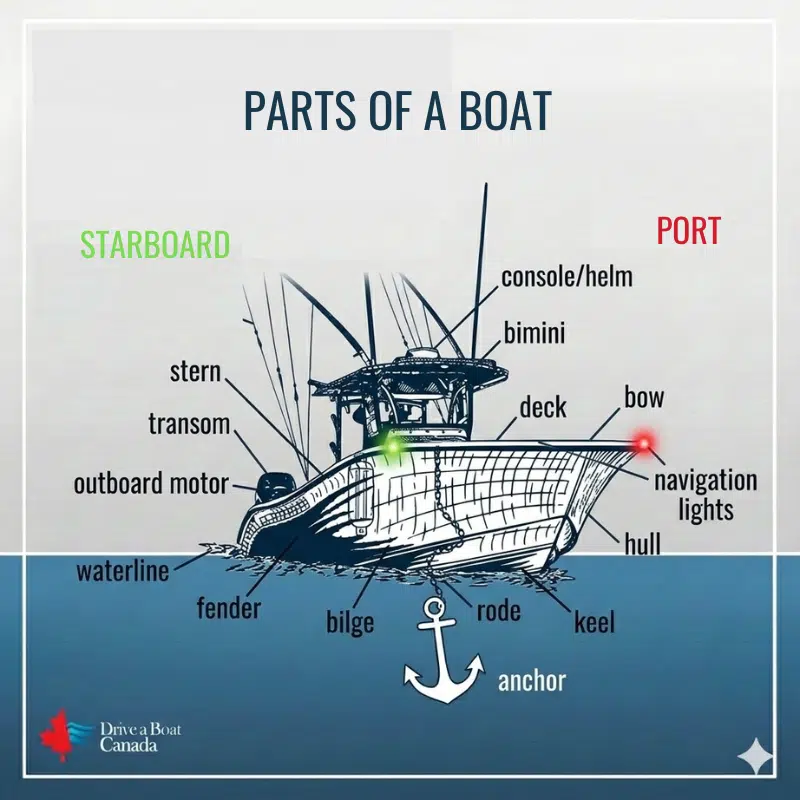
Hull and Structure
Anchor
An anchor is a heavy device, typically made of metal, designed to secure a vessel to the seabed and prevent it from drifting due to wind or current.
Bilge
The bilge is the lowest indoor space where water collects and is drained off.
Bimini
A bimini is a canvas or composite top that provides shade and shelter for the cockpit or deck of a boat.
Bow
The bow is the front or forward part of a boat. Bows help boats stay above waves by taking the boat over the next wave instead of breaking the wave in half.
Bulkhead
The bulkhead is a wall or partition dividing the hull into compartments.
Cleats
Cleats are metal fixtures used to attach a rope or cable from your boat to the dock.
Deck
The deck is the flat surface area on the boat for passengers or cargo.
Fenders
Fenders are protective devices made of rubber, foam, or inflatable vinyl designed to prevent damage to a boat’s hull during docking or mooring by acting as a cushion between the boat and docks, pilings, or other vessels.
Galley
Galley is the nautical term for the kitchen area on larger boats.
Gunwale
The gunwale (pronounced “gunnel”) is the upper edge of the side of a vessel where the deck meets the hull. It gives the hull additional rigidity.
Head
The toilet facilities on a boat are called the “head”.
Hull
The hull is the main body of a vessel from the deck down, the part of the boat that floats in and sits above the water. There are various types of hulls.
Keel
The keel is a long, thick beam that runs from the bow to the stern in the midline of the bottom of a boat (primarily on sailboats).
Stern
The back or rear part of a boat is called the “stern”. On most boats, the engines are located at the stern, while others use it for storage or seating.
Transom
The transom is the flat panel at the stern where an outboard motor is attached. On some boats, it is also used to attach a ladder (reboarding device).
Waterline
The waterline is an invisible line that divides the submerged section of a boat from the above-water section.
Navigation and Control
Console
The console is the area housing the boat’s controls and instruments.
Helm
The helm collectively refers to all aspects of steering a boat, including engine controls, the joystick, and the wheel, all located within the console. The type of boat will determine which specific components make up the helm.
Rudder
A rudder is a flat, vertical control surface located at the stern of a boat, used to steer the vessel by directing the flow of water as it moves through the water.
Port
The port refers to the left side of a watercraft looking forward. For navigation purposes, it is essential to understand and use this term, and to know how it applies to buoys and markers. Tip for remembering which side is port: port and left both have 4 letters.
Starboard
The starboard refers to the right side of a watercraft looking forward. For navigation purposes, it is essential to understand and use this term, and to know how it applies to buoys and markers.
Navigation lights
Navigation lights are a mandatory piece of safety equipment on most boats. The most common are red and green sidelights, as well as all-around white lights, which are found on powerboats.
Propulsion and Anchoring
Boom
The boom is a horizontal spar extending from the mast (sailboats).
Centerboard
The centreboard is a removable center fin found on sailboats.
Mooring Line
A mooring line is used to secure a boat to a fixed point, such as a mooring buoy or dock. Mooring is generally more permanent or long-term than anchoring.
Outboard motor
An outboard motor is mounted externally on the transom of a boat.
Propeller
A propeller is a device with blades and a rotating hub used to move a boat forward or backward through water.
Rode
“Rode” refers to the combination of the anchor line (which can be rope, chain, or a combination of both) and the anchor itself.
Sail (for sailboats)
A sail is a triangular or rectangular piece of material attached to a boat’s mast and used to catch the wind.
Spar
A spar is a pole made of wood, metal, or lightweight materials like carbon fiber, used in the rigging of a sailing vessel to carry or support a sail.
Boat Measurements
Beam
The beam is the width of the vessel at its widest point. Larger beams make boats more stable.
Deadrise
The deadrise is the angle of a powerboat hull’s “V” shape, measured in degrees at the transom.
Displacement
Displacement refers to the weight of water displaced by the boat’s hull.
Draft
The draft is the distance from the waterline to the keel of a boat.
Dry weight
Dry weight refers to the weight of a boat without fuel or water on board.
Freeboard
The freeboard is the distance from the waterline to the gunwale of a boat.
Scope
The scope of a vessel is the ratio between the length of anchor rode and the vertical distance from the bow of the boat to the sea floor.
Get your boating licence with Drive A Boat Canada!
We offer a comprehensive online course leading to lifetime certification. Register with Drive a Boat Canada today, and learn everything you need to know to pass the boating exam. With your boating licence (PCOC), you can take to the water legally anywhere in the country.
Latest articles

Rules for Naming or Renaming a Boat in Canada
A boat’s name often reflects the entire journey that led to buying your own pleasure craft. Whether it represents a hard-earned retirement, a tribute to a loved one, or a symbol of freedom, putting that name on the hull is a special moment. In Canada, there are a few rules you need to follow for Read more ›

New HIN Rules in Canada
Since 1981, boats used in Canada have needed a Hull Identification Number (HIN), also called a Hull Serial Number. In 2026, Canada’s Minister of Transport made some changes to the Small Vessel Regulations (SOR/2010-91) which impact the original (HIN) rules. For recreational boaters, this means better tracking of vessel ownership and better accountability in case Read more ›
Canada’s PCOC and PCL Rules in 2026
As of December 31, 2025, Transport Canada implemented significant updates to the Pleasure Craft Licence (PCL) system. However, there have been no changes to the Pleasure Craft Operator Card requirements for Canadian boaters. Not sure what this means for your next boating trip? Keep reading to find out what each licence is for and what Read more ›