Home / Boating Safety Manual / Types of Boat Hulls: Every Hull Shape and Design Explained
10% OFF WITH CODE:
BLACKFRIDAY10
Your boat’s hull type determines how fast it goes, how well it maneuvers, and how smooth the ride feels. It also impacts storage and deck space.
Recreational boaters need to know what each type of boat hull is good for, so they can choose the right type of vessel for their chosen boating activity. It’s an important part of enjoying safe navigation on Canadian waterways.
Key takeaways
- There are three main categories of boat hulls: displacement, planning and multihull.
- Displacement hulls include round-bottom hulls
- Planing hulls can be flat bottom or v-shape.
- Multihulls include catamarans, trimarans, and pontoons.
- Each type of hull features different advantages and disadvantages in terms of performance and comfort. Boaters should understand the implications of hull type on their boating activities.
Table of contents
- The 3 Main types of boat hulls
- 1. Displacement hulls
- Round bottom hulls
- 2. Planing hulls
- Flat bottom hulls
- V-shape
- 3. Multihulls
- Catamaran
- Trimaran
- Pontoon
- Frequently Asked Questions
The 3 Main types of boat hulls
No matter their shape or size, all boat hulls are designed for one of two purposes: they either displace water or plane (ride on top of it).
There are three main types of hulls: displacement hulls, planing hulls and multihulls.
Let’s look at each type in more detail.
1. Displacement hulls
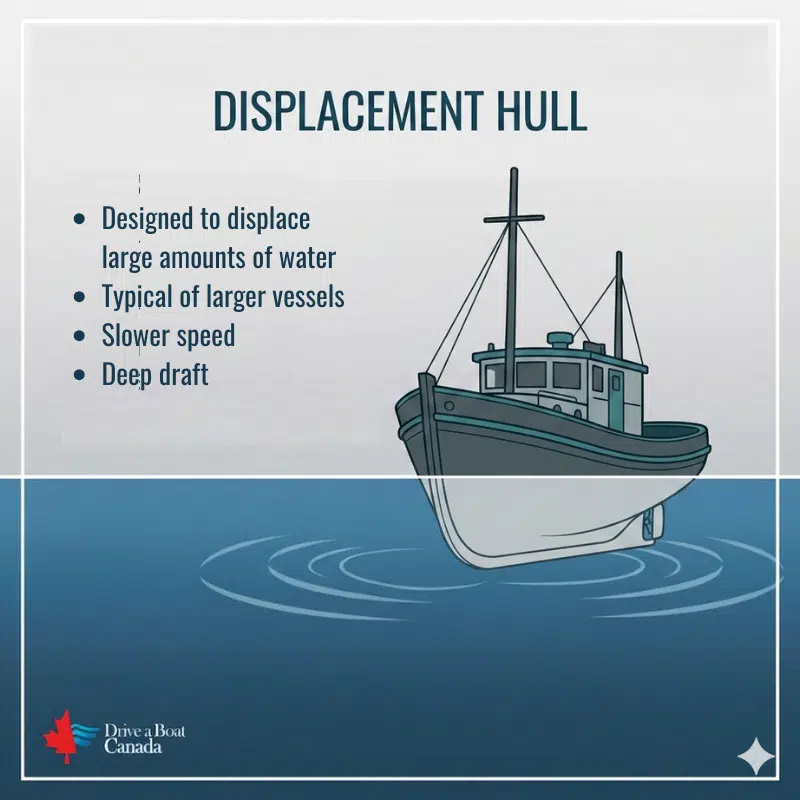
Displacement hulls lie in the water and displace it when moving. This generates a lot of resistance, so boats with displacement hulls tend to be slower. Water resistance increases as the speed increases, creating a kind of built-in speed limit called hull speed or displacement speed.
Displacement hulls tend to have a deep draft. That means that more of the boat’s hull is in the water, which makes it easier to handle in waves and rough conditions. Most sailboats, cruisers and cargo ships that need to cross oceans have displacement hulls for this reason.
Round bottom hulls
Most displacement hulls are designed with round bottoms because the rounded shape offers the least resistance and displaces water most efficiently. Round-bottom hulls provide a very smooth, comfortable ride. Their major drawback is instability—boats with round bottoms are prone to rocking and capsizing. A deep keel (often found on sailboats) can help improve stability.
2. Planing hulls
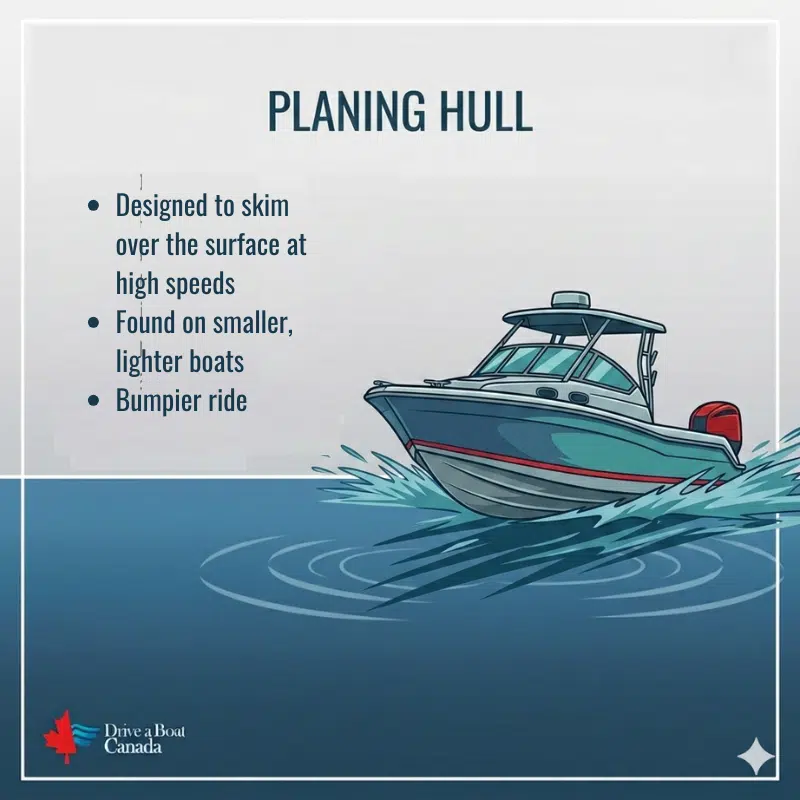
Planing hulls are usually found on smaller, lighter boats that are built for speed. Planing hulls displace water when moving slowly, but as they go faster, the shape of the hull and the speed work together to generate lift, bringing the boat right out of the water so that it skims over the surface.
Boats with planing hulls can move much faster than those that displace water, but they make for a bumpier ride and are more easily affected by gusts of wind.
Flat bottom hulls
Flat-bottom hulls are designed to sit on top of the water and displace very little while underway. Boats with flat bottoms can go quite fast because of the lack of resistance, but if the water is choppy at all, the hull will pound against each wave, making for a very uncomfortable ride. Flat-bottom boats are quite stable in that they won’t rock or capsize, but the wind can easily blow them off course due to their extremely shallow draft.
Flat-bottom boats tend to be less expensive to build and require less power to operate because they don’t need lift to skim over the surface of the water. The flat bottom also maximizes space inside the boat. However, it’s best to use them on calm, inland waters, because they can be uncomfortable and unwieldy in more challenging conditions.
V-shape
V-shaped hulls are designed to provide a smoother ride in rough water than flat-bottom boats, but it takes more power for them to reach the same speed.
Deep V
This type of hull has a deep V-shape that runs all the way from the bow to the stern. The shape of the hull acts like a small keel, providing the boat with more stability and maneuverability than a flat bottom while maintaining very fast speeds. Unfortunately, the sharp angle of the hull results in less interior space for storage, boat safety equipment and accommodations.
Modified V
Modified V hulls have a flat bottom at the stern that gradually transitions to a V shape towards the bow. The flat stern provides speed and stability while the V-shaped bow improves maneuverability. This type of boat hull is the ultimate compromise—it has a little of everything but doesn’t truly excel in any category.
3. Multihulls
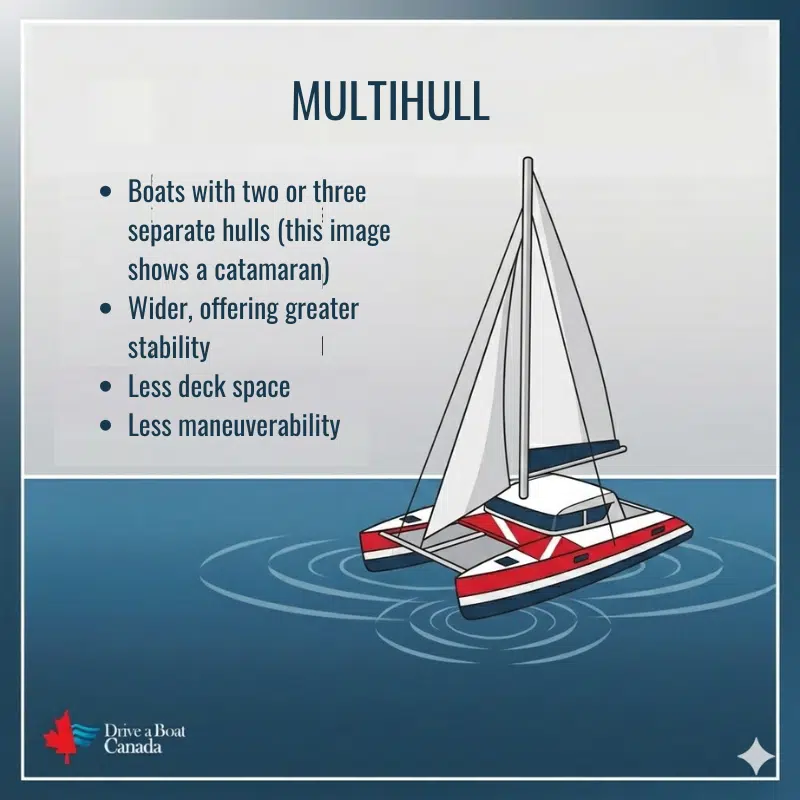
Multi-hulls are boats with two or three separate hulls. They tend to be very wide, which increases stability and provides extra deck space but makes them less maneuverable.
Catamaran
Catamarans have two hulls with a deck stretching between them. While they are displacement hulls, they have a very shallow draft, meaning that not much of the boat is actually in the water. This makes them a great choice for navigating shallow waters and reefs.
The main drawback with catamarans is their width, which gives them a very wide turning radius and makes them very costly to moor at marinas.
Trimaran
There are two types of trimarans. One is similar to a catamaran, just with three hulls instead of two. The other, often called a folding trimaran, has one main displacement hull with two floats or pontoons, one on each side.
As its name suggests, the main advantage of a folding trimaran is that the floats or pontoons can be folded away when mooring or transporting the boat.
Pontoon
Pontoons are airtight, hollow floats that are extremely buoyant. Pontoon boats generally consist of a wide deck mounted on two or more pontoons. These are planing multihulls that float on top of the water. They are very stable, but tend to be slow and lack maneuverability.
Get your boating licence with Drive A Boat Canada!
We offer a comprehensive online course leading to lifetime certification. Register with Drive a Boat Canada today, and learn everything you need to know to pass the boating exam. With your boating licence (PCOC), you can take to the water legally anywhere in the country.
Frequently Asked Questions
Deep-V Hulls are generally considered the best for cutting through waves and providing a smoother ride in choppy or rough conditions. Catamarans, with their twin parallel hulls, offer exceptional stability. Choosing the right hull for rough water also depends on how quickly you want to travel.
When it comes to pure speed, the fastest hull types are those designed to plane.
Multi-Hulls (Catamarans and Trimarans are widely considered the most stable boats, because their hulls are wide apart. Flat-bottom hulls provide excellent initial stability in calm, shallow water.
The most fuel-efficient hull type depends heavily on the intended speed and purpose of the boat. Full displacement hulls are exceptionally fuel-efficient at slow speeds, while planing hulls (especially those with advanced designs) are particularly efficient at higher speeds.
Hull speed is a theoretical speed limit for boats with displacement hulls. This limit occurs because the boat gets “trapped” by its own bow and stern waves, requiring exponentially more power for minimal speed gains. The hull speed is primarily determined b y the boat’s waterline length. This concept does not apply to planing hulls.
Latest articles

Is Your Boat a Pleasure Craft? Know the Law to Avoid Fines
A pleasure craft (whether it’s a canoe, kayak, motorboat or sailboat) is a boat that is used exclusively for recreational boating. Getting your Pleasure Craft Operator Card allows you to legally operate a pleasure craft anywhere in Canada where motorized vessels are permitted. However, it does not allow you to use your vessel for commercial Read more ›

All About Canada’s New Life Jacket Labels
Canada recently transitioned to new life jacket labels, and many boaters are wondering which life jackets they can use for recreational boating activities. You may also be asking whether you can use your old life jacket, what the icons on the new labels mean, and whether the same boating safety equipment rules still apply. Here Read more ›

Rules for Naming or Renaming a Boat in Canada
A boat’s name often reflects the entire journey that led to buying your own pleasure craft. Whether it represents a hard-earned retirement, a tribute to a loved one, or a symbol of freedom, putting that name on the hull is a special moment. In Canada, there are a few rules you need to follow for Read more ›