10% OFF WITH CODE:
BLACKFRIDAY10


New HIN Rules in Canada
June 11, 2026
Since 1981, boats used in Canada have needed a Hull Identification Number (HIN), also called a Hull Serial Number. In 2026, Canada’s Minister of Transport made some changes to the Small Vessel Regulations (SOR/2010-91) which impact the original (HIN) rules.
For recreational boaters, this means better tracking of vessel ownership and better accountability in case of manufacturing issues or reckless boating incidents, and during search and rescue efforts.
Key Takeaways
- A Hull Identification Number must be displayed correctly on your boat’s hull, and also in another hidden location on your boat.
- Standard HIN rules in Canada apply to the size and location of lettering. If these rules are not followed, fines will apply.
- New rules also apply to the renewal of Pleasure Craft Licences, which display a vessel’s HIN. Changes to vessel data or address must be made within 30 days and failing to keep your information up to date and coherent will lead to fines.
What is a Hull Identification Number?
A Hull Identification Number (HIN) is a unique 12-character code that you need to display permanently in two places on your boat.
Under Transport Canada’s regulations, every pleasure craft built or imported for sale in Canada needs a valid HIN.
Purpose of a HIN
The HIN is used by Canadian authorities to trace vessels that have been stolen, perform recalls, to identify vessels being operated recklessly or for other safety reasons, such as identifying a boat that has called for help.
Old HIN Rules That Still Apply
Some HIN rules have not changed. Boaters still need to follow these rules to adhere to Canadian Boating Laws and avoid fines:
Where to display your HIN
Under Section 903 of the Small Vessel Regulations, your HIN must be displayed in two locations on your boat.
It must be displayed using block letters and numbers at a minimum height of 7.5 cm / 3 inches.
On the hull
You need to display your HIN permanently on the upper starboard (right) quarter of the outside surface of the transom or the uppermost starboard side at the aft (rear) end of the hull. It must be clearly visible when the boat is in the water.
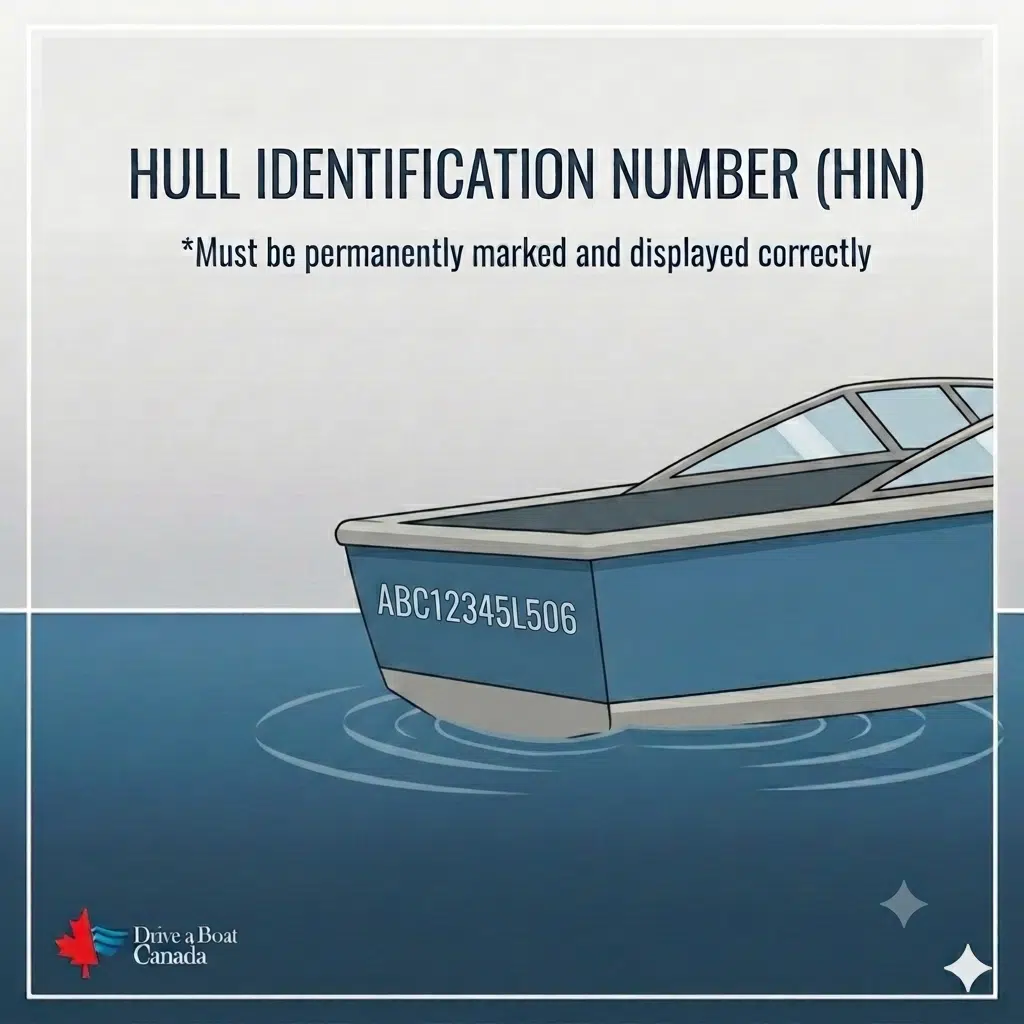
HIN In a second hidden location
Builders or importers must place the HIN in a hidden second location (either beneath a hardware fitting or unexposed on the interior). They are required to keep a record of this location and provide it to inspectors upon request.
HIN Format
A standard Canadian Hull Serial Number is 12 digits long (excluding an optional 2-character country code like CA).
It includes:
- Manufacturer Identification Code (MIC): The first 3 characters identify the builder or importer.
- Unique Serial Number: The next 5 characters designate the specific vessel serial number.
- Date of Construction: The 9th and 10th characters show the month and year construction began.
- Model Year: The final 2 characters indicate the model year of the boat.
Example of an HIN:
ABC12345L506
Fines for incorrectly displayed HINs
If your Hull Identification Number (HIN) is not displayed correctly, you could be fined from $250 to $500.
3 New HIN Rules in Canada in 2026
Abandoned, hazardous, and wrecked vessels are becoming a bigger problem in Canadian waterways. That’s why the new HINs rules make it easier to track boat ownership and identify vessel manufacturers.
1. New Pleasure Craft Licence (PCL) Rules
Your PCL holds the permanent record of your vessel’s HIN. It is requested as part of your application for a PCL. PCLs used to be good for life, but this meant there could be incorrect, outdated HIN information on your licence.
Under the new Pleasure Craft Licence rules, PCLs expire after 5 years and vessel data has be to validated if you want to operate your boat legally.
2. Data changes and transfers of ownership have to be made within 30 days
If you make changes to your boat or change your address, you must update Transport Canada’s database within 30 days. There is no fee if you do this within the allotted timeframe. New owners must also apply for a HIN/PCL transfer within 30 days of purchase.
3. Fines for invalid data
If you operate an unregistered vessel, have a completely missing/altered HIN, or navigate with an expired licence, you can be fined up to $5,000. You may also face vessel seizure and potential criminal charges (if authorities suspect theft or fraudulent activity).
Learn All About Boating Rules and Regulations with Drive A Boat Canada
There are Canadian laws covering many aspects of recreational boating, including boating safety equipment, navigation rules, and boat capacity.
In addition to displaying a correct HIN, all pleasure craft operators need to hold a valid Pleasure Craft Operator Card (PCOC) to take to the water legally. To get your card, just follow the approved Drive A Boat Canada online boating course and take the Transport Canada boating exam. We offer unlimited free retries!
Register to get your boater card today!