Home / Boating Safety Manual / Boat Distress Flares: Types and Regulations in Canada
10% OFF WITH CODE:
BLACKFRIDAY10
Everyone operating a recreational vessel in Canada is responsible for following Canadian boating laws and regulations. This includes using the correct type and number of boating distress flares.
Key takeaways
- Recreational boaters in Canada use distress flares to signal that they heed help. They cannot be used or tested for any other purpose.
- There are five approved types of flares that can be used to signal distress: Rocket parachute flares (Type A), Multi-star flares (Type B), Hand-held flares (Type C), Buoyant or hand smoke signal flares (Type D), Watertight flashlight.
- Boaters are responsible for storing their flares in a cool, watertight location.
- Flares must be approved by Transport Canada and used according to the manufacturer’s instructions.
- Boaters must have the correct type and number of flares on their boat if they are navigating more than 1 nautical mile from shore.
- Flare requirements vary according to boat size and type.
- As of 2021, Transport Canada also allows boaters to use Electronic Visual Distress Signal Devices (eVDSD).
Table of contents
- Types of distress flares
- Rocket parachute flares (Type A)
- Multi-star flares (Type B)
- Hand-held flares (Type C)
- Buoyant or hand smoke signal flares (Type D)
- Watertight flashlight
- Distress flares rules and maintenance
- Distress flares requirements according to boat type
- How to use distress flares safely and legally
- 5 Steps for using a distress flare
- Frequently Asked Questions
Types of distress flares
Distress flares are used to send a distress signal. The requirements vary depending on boat type.
You may not need to carry a flare depending on your boat size and where you are navigating. For example, flares are not required if you are boating on a river, canal or lake where you will never be more than 1 nautical mile (1.852 km) from shore.
Rocket parachute flares (Type A)
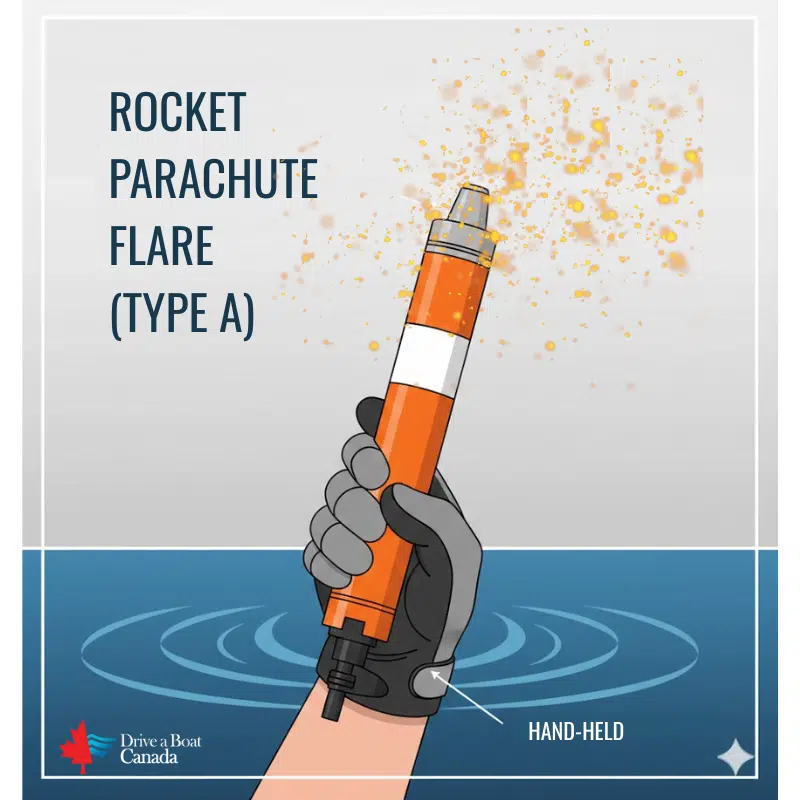
This type of flare has a rocket that launches it 300 metres (984 feet) into the air, then produces a single red star. After the flare reaches its peak height, a parachute deploys and it descends slowly, burning bright red for at least 40 seconds. It can be seen up to 20 nautical miles away from the ground or air.
Multi-star flares (Type B)
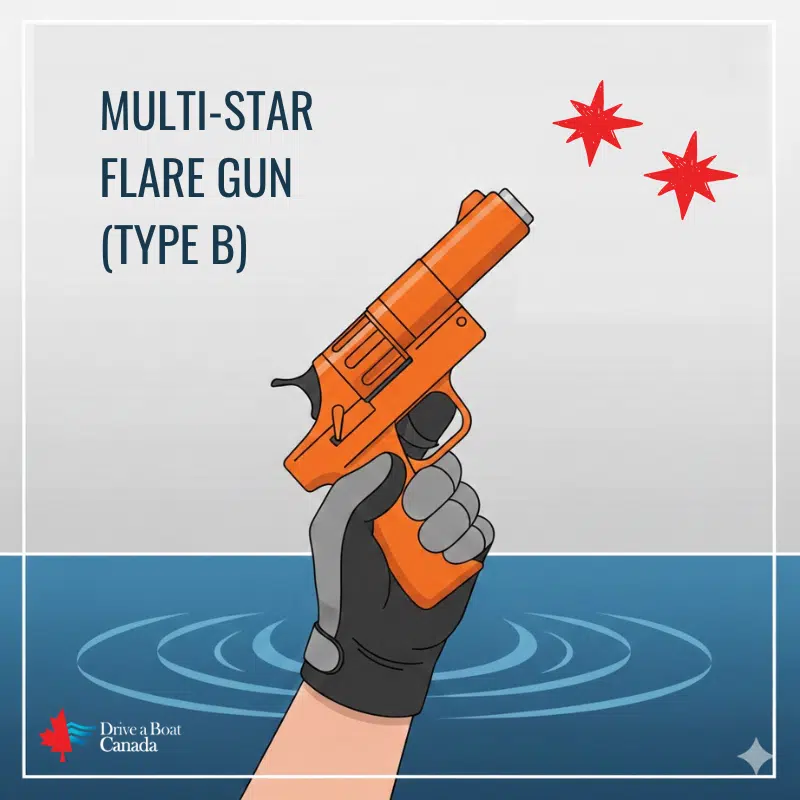
This type of flare produces two or more bright red stars at intervals of 15 seconds or less. Each star burns for 4 to 5 seconds. The flare has a maximum height of 100 metres (328.1 feet) and can be seen up to 12 nautical miles away, from the ground or air.
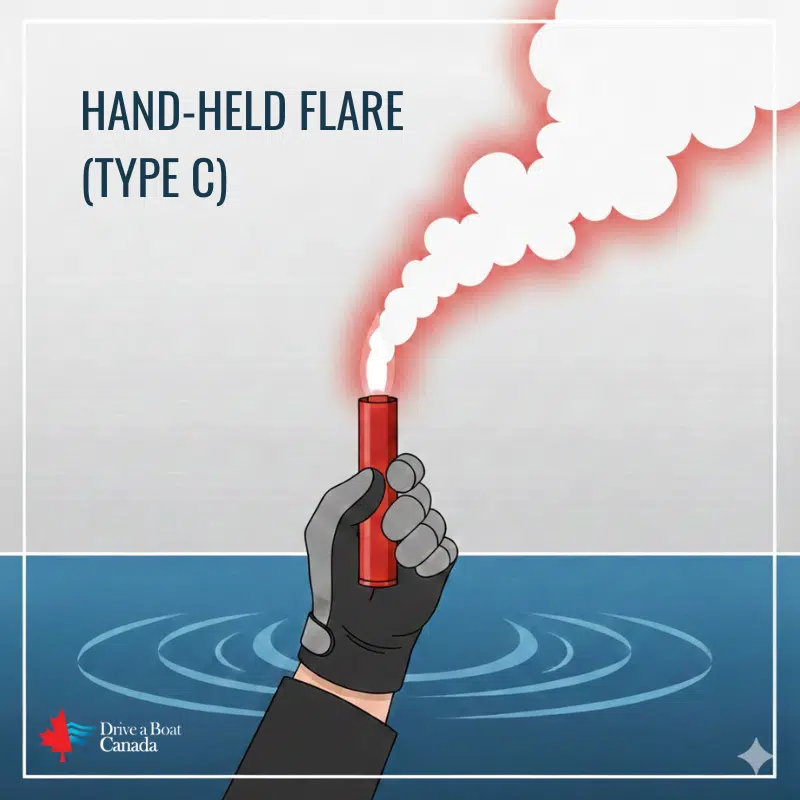
Hand-held flares (Type C)
These are hand-held red flares that burn for at least a minute. They are more visible from the air than from the ground.
Handheld flares are designed for short-range, line-of-sight signaling and are most effective when you are reasonably sure that a rescuer (another boat, aircraft, or someone on shore) is within visual range. They are particularly useful for pinpointing your exact location once search and rescue efforts are already underway.
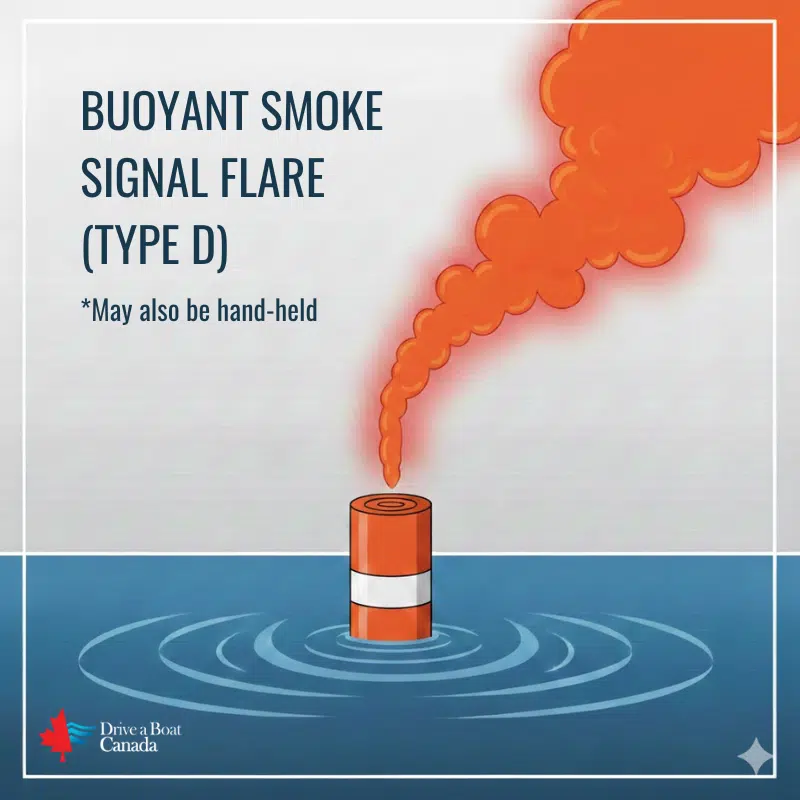
Buoyant or hand smoke signal flares (Type D)
Smoke signals can be either hand-held or buoyant. The buoyant type emits dense orange smoke for at least 3 minutes in calm water. The hand-held type emits the same kind of smoke for at least a minute. Smoke signals are only effective in daylight.
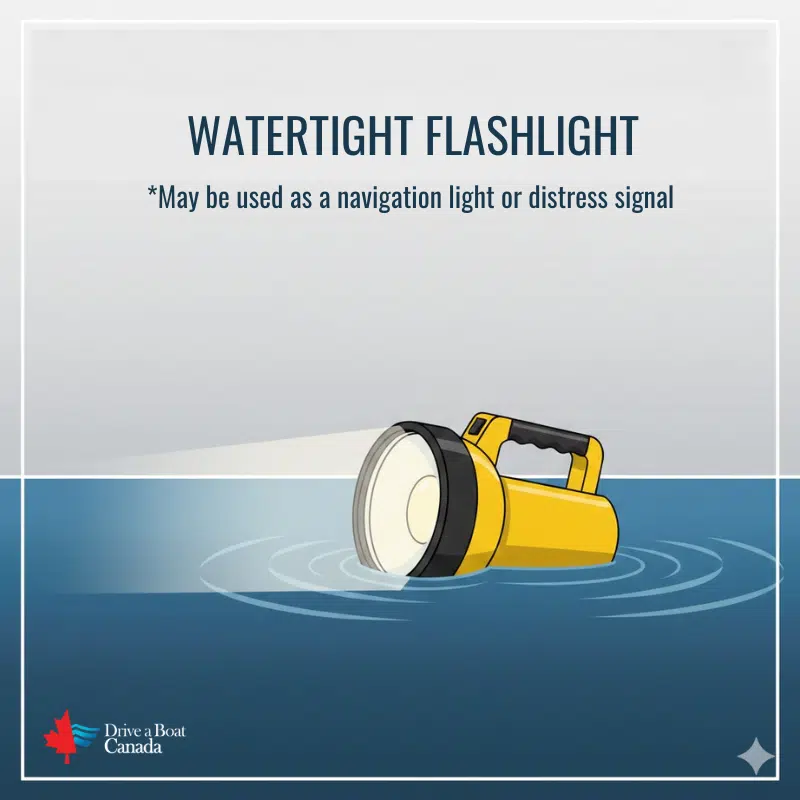
Watertight flashlight
A watertight flashlight is a required piece of safety equipment on recreational vessels in Canada. It must be able to float and to continue functioning in the water to qualify as visual signalling equipment. A watertight flashlight can be used to signal for help in an emergency.
A watertight flashlight also qualifies as a navigation light on non-powered vessels and sailboats less than 7 metres in length.
Distress flares rules and maintenance
Distress flares must:
- Be stored vertically in a cold, dry location, ideally a watertight container. It’s important to keep them away from heat sources, flammable liquids and gas. They should be kept close at hand so that they are easily accessible in the event of an emergency.
- Be approved by Transport Canada
- Be used according to the manufacturer’s instructions
- Be used within 4 years of the date of manufacture. To dispose an expired flare, contact your local fire department or police department, the Canadian Coast Guard, or ask your retailer what to do with them.
Always check that the batteries in your watertight flashlight work before you head out on the water.
Distress flares requirements according to boat type
| Vessel Length | Standard Requirement (Total Flares) | Maximum Number of Smoke Signals (Type D) Allowed in Total | Requirement if Carrying an Electronic Communication Device |
|---|---|---|---|
| Up to 6m (19’8″) | 3 (Types A, B, or C) | 1 | 3 (No change) |
| 6m to 9m (19’8″–29’6″) | 6 (Types A, B, or C) | 2 | 3 (Max 1 smoke) |
| 9m to 12m (29’6″–39’4″) | 12 (Types A, B, C, or D) | 6 | 6 (Max 3 smoke) |
| Over 12m (39’4″+) | 12 (Types A, B, C, or D) | 6 | 6 (Max 3 smoke) |
In this table, an electronic communication device refers to:
- A means of two-way communication (such as VHF Radio or mobile phone),
- A 406 MHz personal locator beacon worn by the boat operator, or
- A 406 MHz emergency position-indicating radio beacon (EPIRB).
How to use distress flares safely and legally
Never use a distress flare unless there is a real emergency. Using a distress flare for any purpose other than to signal an emergency violates the Crimial Code of Canada.
Note: Boaters in Canada are legally obliged to render assistance to other boaters in distress.
5 Steps for using a distress flare
- Assess whether you are experiencing a genuine emergency.
- Decide whether your flares are likely to be seen by rescuers (e.g., another vessel or aircraft in sight, or within reasonable distance of shore).
- Check that the flares are in good working condition and check the expiration date. Expired flares may not function reliably.
- Read the manufacturer’s instructions thoroughly for each specific type of flare you carry; firing mechanisms and deployment procedures can vary significantly.
- When ready to use, consider the wind direction and any obstructions, and always hold the flare downwind and away from your body and the vessel to prevent burns or accidental ignition of flammable materials. Aerial flares should be fired at an upward angle (45° to 60°) angle. In strong winds, lower the angle, but do not fire it below 45°.
Get your boating licence with Drive A Boat Canada!
We offer a comprehensive online course leading to lifetime certification. Register with Drive a Boat Canada today, and learn everything you need to know to pass the boating exam. With your boating licence (PCOC), you can take to the water legally anywhere in the country.
Frequently Asked Questions
In Canada, appropriate visual distress signalling equipment is a required boating safety item. The specific type and number of flares required depend on the size of your vessel and the body of water you’re navigating.
Always check your local maritime regulations to verify the rules and regulations for your area, as failure to carry the required safety equipment can result in fines. If you operate further than 1 nautical mile from shore or on any ocean, flares are mandatory.
It is generally always illegal to test or discharge a distress flare, since they are regulated safety devices designed for signaling distress to attract rescue. Flares can only be used when you are in a genuine emergency situation. Using a flare if there is no emergency can have serious consequences, including fines and unnecessary deployment of search and rescue resources.
Yes. As of 2021, Transport Canada allows Electronic Visual Distress Signal Devices (eVDSD) that meet the RTCM Standard 13200.0.
If you switch to an electronic flare, you must still carry one Type D pyrotechnic flare for daytime use.
Electronic flares do not expire (though batteries must be maintained) and are generally safer to handle.
Technically, you can use a distress flare while your boat is underway, but it is generally safer and more effective to slow down or stop if the emergency allows. Always fire or hold the flare downwind. If possible, delegate the flare duty to a passenger so the captain can focus 100% on steering.
Sources
- Government of Canada Tier I – Policy – Acceptance of Electronic Visual Distress Signals in lieu of Pyrotechnic Distress Signals on pleasure craft. Marine Safety Management System. https://tc.canada.ca/en/marine-transportation/publications/marine-safety-management-system/tier-i-policies/tier-i-policy-acceptance-electronic-visual-distress-signals-lieu-pyrotechnic-distress-signals-pleasure-craft
- Government of Canada Radiocommunication Act (R.S.C., 1985, c. R-2) Department of Justice https://laws-lois.justice.gc.ca/eng/acts/r-2/page-3.html
- Government of Canada Criminal Code (R.S.C., 1985, c. C-46) Department of Justice https://laws-lois.justice.gc.ca/eng/acts/r-2/page-3.html
- Government of Canada Canada Shipping Act, 2001 (S.C. 2001, c. 26). Department of Justice. https://laws-lois.justice.gc.ca/eng/acts/C-10.15/section-131.html
- Transport Canada. Distress Signals. Office of Boating Safety https://tc.canada.ca/sites/default/files/2021-05/TP%2015446E.pdf
- Transport Canada. SAFE BOATING GUIDE. [PDF]. https://tc.canada.ca/sites/default/files/2024-03/tp_511e.pdf
Latest articles
Canada’s PCOC and PCL Rules in 2026
As of December 31, 2025, Transport Canada implemented significant updates to the Pleasure Craft Licence (PCL) system. However, there have been no changes to the Pleasure Craft Operator Card requirements for Canadian boaters. Not sure what this means for your next boating trip? Keep reading to find out what each licence is for and what Read more ›
All About Ontario Boating and Fishing Licences
Planning a fishing trip in Ontario? If you plan on using a motorized boat, you’ll need to bring along both your boating and fishing licenses. Let us walk you through the process of obtaining these federal and provincial licenses, so that you can enjoy Ontario’s beautiful waterways legally as soon as the season opens. Read more ›
Guide to Registering a Boat in Canada
In most cases, boat registration in Canada is optional. However, most boaters will need to obtain another similar piece of documentation, a Pleasure Craft License (PCL). Let’s take a look at the details. The difference between a Pleasure Craft License and Vessel Registration Getting a Pleasure Craft License is one thing. Registering your boat is Read more ›