Home / Boating Safety Manual / All About Isolated Danger Buoys
10% OFF WITH CODE:
BLACKFRIDAY10
Isolated danger buoys notify boat operators of a specific type of threat to their vessel’s safety.
They mark an isolated hazard that has navigable water all around it. The buoy is placed directly on or immediately above the danger itself.
Isolated danger buoys use the Canadian Aids to Navigation System (CANS) managed by the Canadian Coast Guard, aligning with Transport Canada’s regulatory framework for marine safety.
Key takeaways
- Isolated danger buoys indicate an isolated threat, either natural or man-made.
- Boaters can navigate around IDBs, relying on nautical charts for details about the specific threat.
- Boaters must be able to recognize isolated danger buoys by their colour: black with one broad red horizontal band. Other elements of the buoy’s appearance may vary.
Table of contents
- Types of dangers indicated by an isolated danger buoy
- Natural dangers indicated by an isolated danger buoy
- Man-made dangers indicated by an isolated danger buoy
- What do isolated danger buoys look like?
- What to do when you encounter an isolated danger buoy
- Frequently Asked Questions
Types of dangers indicated by an isolated danger buoy
IDBs can indicate both natural and man-made dangers.
Natural dangers indicated by an isolated danger buoy
An IDB can indicate natural dangers, such as:
- Shoals (or banks): Areas where the seabed rises close to the surface, creating shallow water. This is one of the most common natural hazards marked by an IDB.
- Submerged rocks or boulders: A single, large rock formation or group of boulders that may not be covered by enough water for safe passage.
- Reefs: Underwater ridges of coral that are isolated from other coastal hazards.
- Underwater hills: Natural elevations on the seabed that come dangerously close to the waterline.
Man-made dangers indicated by an isolated danger buoy
IDBs can also indicate man-made dangers, including:
- Submerged shipwrecks: A sunken vessel or part of a vessel that rests on the bottom, posing a grounding or collision risk, but is small enough or situated such that navigable water exists on all sides.
Note: For new, uncharted, and dangerous wrecks, a special Emergency Wreck Buoy (blue and yellow vertical stripes) is often used first, before a permanent mark like an IDB is established.
- Construction debris and other obstructions: Isolated piles of material, or remnants of temporary structures (like old piers or moorings) left on the seabed from engineering, dredging or other industrial operations.
- Submerged equipment: Lost or abandoned equipment, heavy anchors, or other substantial objects that have fallen to the seafloor and pose a threat.
- Disused or damaged fixed structures: The remains of old beacons, piles, or other fixed aids to navigation that have been knocked down or damaged but still leave a hazardous base on the seafloor.
What do isolated danger buoys look like?
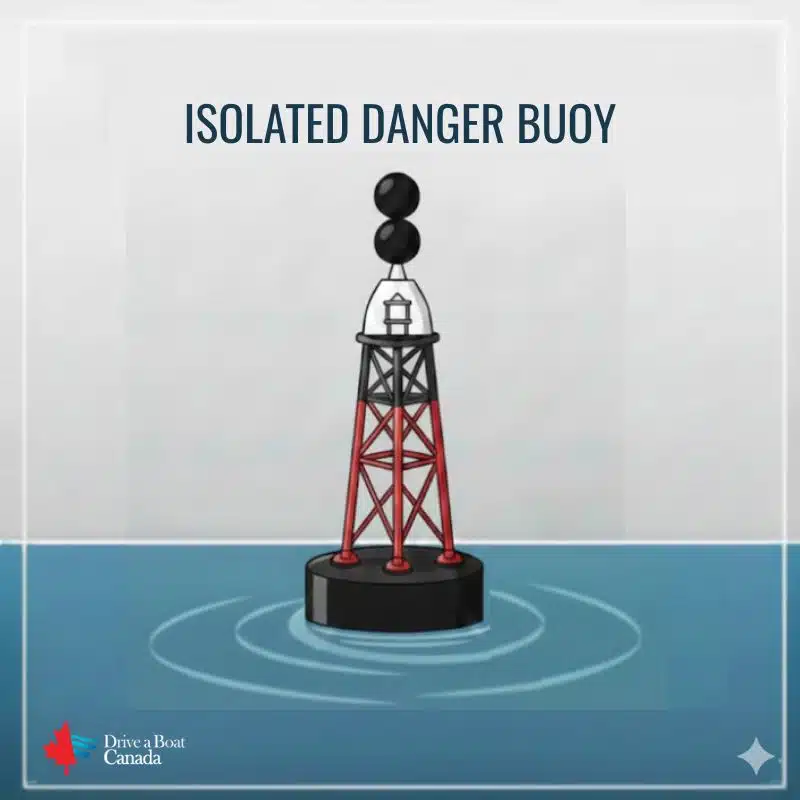
Isolated danger buoys are black with one broad red horizontal band. They are usually spar-shaped, but that isn’t a requirement. If they are equipped with a light or retroreflective material, these will be white. If the buoys have a topmark, it will be two black spheres stacked one on top of the other.
What to do when you encounter an isolated danger buoy
When you encounter an isolated danger buoy, it’s best to check your marine chart for more information about the hazard, such as its dimensions and depth.
Pass clear on any side while keeping a safe distance.
Get your boating licence with Drive A Boat Canada!
We offer a comprehensive online course leading to lifetime certification. Register with Drive a Boat Canada today, and learn everything you need to know to pass the boating exam. With your boating licence (PCOC), you can take to the water legally anywhere in the country.
Frequently Asked Questions
Stay well clear! Since the buoy is positioned directly over the hazard, you must pass at a safe distance on either side. Unlike lateral buoys, there is no designated safe side to pass.
If the buoy is lighted (for night navigation), it will display a white group-flashing Fl(2)5s or Fl(2)10s light.
While major IDBs are usually lighted, in some areas with less traffic or severe weather (like ice), unlighted buoys or unlighted fixed aids may be used. In these cases, you must rely on the buoy’s distinctive colour scheme and topmark during the day, and its white retroreflective material at night, using a spotlight.
Yes. The buoy simply marks the hazard’s location. Your nautical chart will provide further details about the type of danger, such as its exact dimensions, the charted depth over the hazard, and the amount of safe water surrounding it, so you can pass it safely.
Sources
- Government of Canada. The Canadian Aids to Navigation System 2023 Canada Coast Guard. https://www.ccg-gcc.gc.ca/publications/maritime-security-surete-maritime/aids-aides-navigation/index-eng.html#dangerbuoys
- Government of Canada. Canadian Chart 1 Symbols, Abbreviations and Terms Nautical Charts and Serviceshttps://charts.gc.ca/publications/chart1-carte1/sections/q-buoys/iala-eng.html
Latest articles

Is Your Boat a Pleasure Craft? Know the Law to Avoid Fines
A pleasure craft (whether it’s a canoe, kayak, motorboat or sailboat) is a boat that is used exclusively for recreational boating. Getting your Pleasure Craft Operator Card allows you to legally operate a pleasure craft anywhere in Canada where motorized vessels are permitted. However, it does not allow you to use your vessel for commercial Read more ›

All About Canada’s New Life Jacket Labels
Canada recently transitioned to new life jacket labels, and many boaters are wondering which life jackets they can use for recreational boating activities. You may also be asking whether you can use your old life jacket, what the icons on the new labels mean, and whether the same boating safety equipment rules still apply. Here Read more ›

Rules for Naming or Renaming a Boat in Canada
A boat’s name often reflects the entire journey that led to buying your own pleasure craft. Whether it represents a hard-earned retirement, a tribute to a loved one, or a symbol of freedom, putting that name on the hull is a special moment. In Canada, there are a few rules you need to follow for Read more ›