Home / Boating Safety Manual / Manual Water Pump, Bailer & Bilge Pump Requirements
10% OFF WITH CODE:
BLACKFRIDAY10
While boats are ingeniously engineered to stay afloat, they can capsize or sink if enough water gets in. Adverse weather conditions in particular can cause water to accumulate inside a boat and threaten its seaworthiness
That’s why Canadian Small Vessel Regulations require that you always have a manual water pump, bailer, or bilge pump on hand to bail you out. It’s a legally required piece of boating safety equipment.
Key takeaways
- Manual water pumps, bailers and /or bilge pumps are a require piece of boating safety equipment in Canada.
- You may need one or more of these devices on board depending on the size and type of boat you are operating.
Table of contents
- Manual water pumps
- Manual water pump requirements
- Bailers
- Bailer requirements
- Bilge pumps
- Bilge pump requirements
- Frequently Asked Questions
Manual water pumps
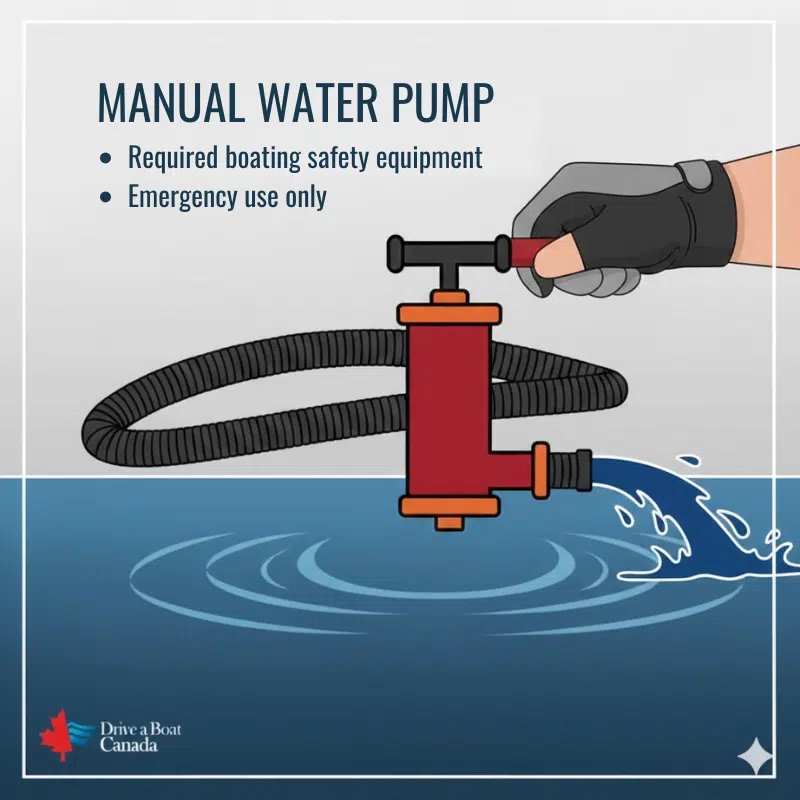
A manual water pump, also known as a manual bilge pump, is a hand-operated pump with a hose attachment that is used to remove water from a boat.
Manual water pump requirements
Sail and power boats between 9 and 12 m in length are required to have a manual water pump on board. Smaller vessels and PWCs can have a manual water pump or a bailer. The pump must be equipped with a hose long enough to reach from the bilge space over the side of the boat. Keep the hose as short as possible though, as the longer the hose, the harder it is to pump water through it.
Bailers
A bailer is a container that is used to manually remove water from a boat. It is the simplest type of water removal device. A homemade bailer can be created by cutting the bottom off of a bottle of bleach or a similar plastic jug.
Bailer requirements
According to the Small Vessel Regulations, bailers must be made of plastic or metal, with a minimum capacity of 750 ml and an opening of at least 65 cm2. Pleasure crafts are required to carry a bailer or other water removal device on board unless their design is such that they cannot retain enough water to make them capsize.
Bilge pumps
Bilge pumps are automated pumps that are built into larger vessels to remove water from the bilge (the lowest part of the boat). Some pumps are equipped with switches that automatically turn them on when the water in the bilge reaches a certain level.
Bilge pump requirements
Sail and power boats over 12 m in length must be equipped with a bilge pump. Like their manual counterparts, bilge pumps must be fitted with a hose or pipes long enough to pump water from the bilge space over the side of the boat.
Get your boating licence with Drive A Boat Canada!
We offer a comprehensive online course leading to lifetime certification. Register with Drive a Boat Canada today, and learn everything you need to know to pass the boating exam. With your boating licence (PCOC), you can take to the water legally anywhere in the country.
Frequently Asked Questions
In an emergency, your boat’s electrical system is often the first thing to fail if the water level rises too high. A manual pump is your fail-safe backup that doesn’t rely on battery power.
It depends on the model and the physical strength of the operator. Most portable hand pumps move about 6 to 10 gallons per minute, while high-capacity fixed pumps can move 15 to 30 gallons per minute.
No. Bilge pumps are designed for relatively clean water (or water with small amounts of oil/debris).
You should test your pump at least once a month when you do other minor boat maintenance (like checking your fire extinguisher) and before any major trip. Pump a few strokes of clean water through it to verify everything is working smoothly.
Tip: Make a habit of checking it when you check your manual propelling device and fire extinguisher.
Generally, no. Most modern pumps use water-lubricated seals. However, always check your specific manufacturer’s manual and follow the instructions for your specific model.
Sources
- Government of Canada Small Vessel Regulations (SOR/2010-91) Department of Justice. https://laws-lois.justice.gc.ca/eng/regulations/SOR-2010-91/section-311.html
- Transport Canada. SAFE BOATING GUIDE. [PDF]. https://tc.canada.ca/sites/default/files/2024-03/tp_511e.pdf
Latest articles

Is Your Boat a Pleasure Craft? Know the Law to Avoid Fines
A pleasure craft (whether it’s a canoe, kayak, motorboat or sailboat) is a boat that is used exclusively for recreational boating. Getting your Pleasure Craft Operator Card allows you to legally operate a pleasure craft anywhere in Canada where motorized vessels are permitted. However, it does not allow you to use your vessel for commercial Read more ›

All About Canada’s New Life Jacket Labels
Canada recently transitioned to new life jacket labels, and many boaters are wondering which life jackets they can use for recreational boating activities. You may also be asking whether you can use your old life jacket, what the icons on the new labels mean, and whether the same boating safety equipment rules still apply. Here Read more ›

Rules for Naming or Renaming a Boat in Canada
A boat’s name often reflects the entire journey that led to buying your own pleasure craft. Whether it represents a hard-earned retirement, a tribute to a loved one, or a symbol of freedom, putting that name on the hull is a special moment. In Canada, there are a few rules you need to follow for Read more ›