Home / Boating Safety Manual / Upstream vs downstream: navigating Canadian waterways
10% OFF WITH CODE:
BLACKFRIDAY10
To boat safely on Canadian waters, you need to stay aware of your direction (upstream vs. downstream) at all times. This is critical because it allows you to:
- Correctly interpret the Canadian Aids to Navigation System (buoys).
- Choose the appropriate side of the channel to avoid collisions.
Key takeaways
- Navigating rivers and channels safely involves knowing the difference between upstream and downstream.
- With an awareness of whether you are travelling upstream or downstream, you can correctly interpret lateral and bifurcation buoys, which indicate which side of a channel to navigate on for maximum safety.
Table of contents
- What’s the difference between upstream and downstream?
- Upstream definition
- Downstream definition
- How to determine whether you’re going upstream or downstream
- How to interpret lateral buoys when travelling upstream
- How to interpret lateral buoys when travelling downstream
- How to interpret bifurcation buoys
- Frequently Asked Questions
What’s the difference between upstream and downstream?
Upstream and downstream refer to the direction a boat is travelling on a body of water with a current.
Upstream definition
Going upstream means moving towards the source of the water. A vessel travelling upstream is heading inland from the sea, against the current.
Downstream definition
Going downstream means moving away from the source of the water. A vessel travelling downstream is heading towards the sea, moving with the current.
How to determine whether you’re going upstream or downstream
There are a few simple ways to determine whether you’re heading upstream or downstream:
- When heading upstream, you’re going against the current. If your boat seems to be fighting the natural flow of the water, you’re likely going upstream.
- If you are entering a waterway from the sea, you’re going upstream.
- Water often flows north to south. If you’re heading north, you’re likely travelling upstream.
- The most reliable way to ascertain whether you’re going upstream or downstream is to consult a marine chart, which will provide information about the current. Always make sure to have up-to-date marine charts with you when boating!
How to interpret lateral buoys when travelling upstream
Lateral buoys mark which side of a waterway (river or channel) boaters should use. Identifying them is key to knowing which side of the river you should be navigating to avoid collisions.
These are the fundamental rules of the CANS (Canadian Aids to Navigation System).
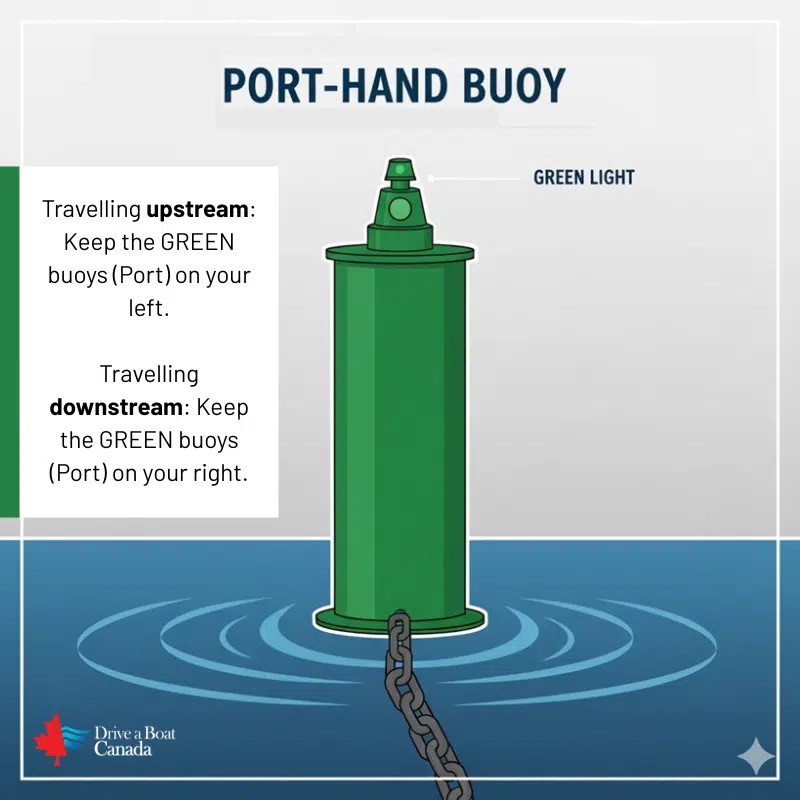
Port-hand buoys
Port-hand buoys are green in colour and should be kept on your port (left) side when heading upstream.
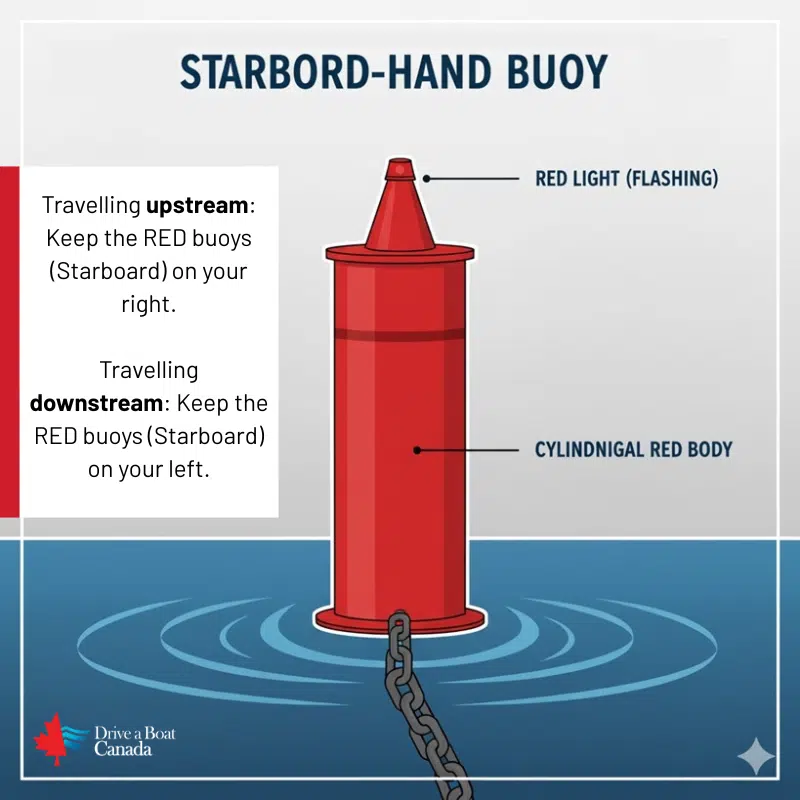
Starboard-hand buoys
Starboard-hand buoys are red in colour and should be kept on your starboard (right) side when heading upstream.
Refer to the buoys to remain on the appropriate side of the channel.
How to interpret lateral buoys when travelling downstream
When travelling downstream, you simply do the reverse of the upstream rule.
Port-hand buoys
Keep the GREEN buoys (Port) on your right.
Starboard-hand buoys
Keep the RED buoys (Starboard) on your left.
Watch our video about interpreting lateral buoys:
How to interpret bifurcation buoys
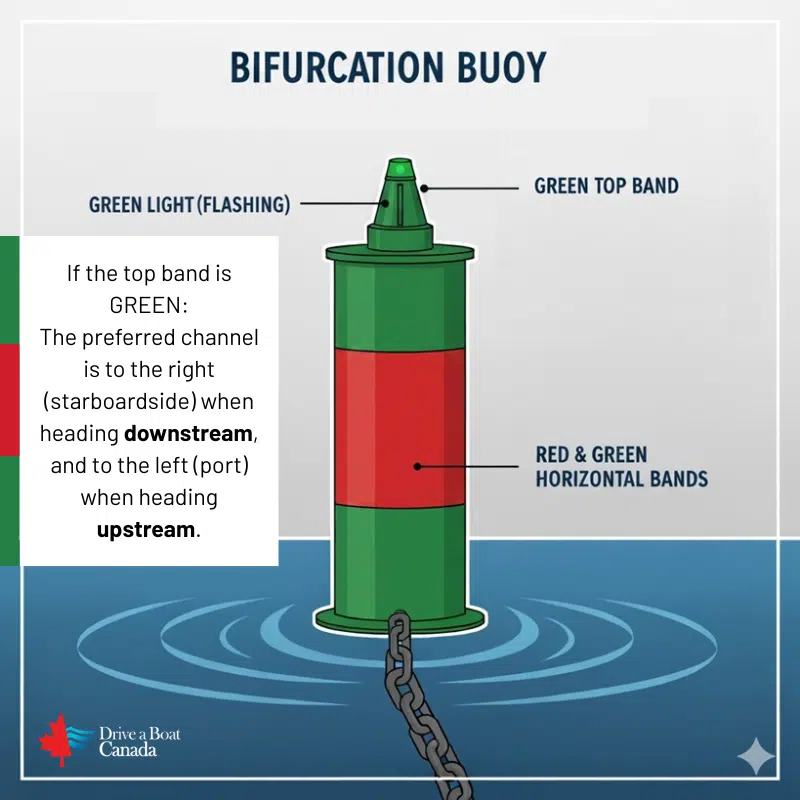
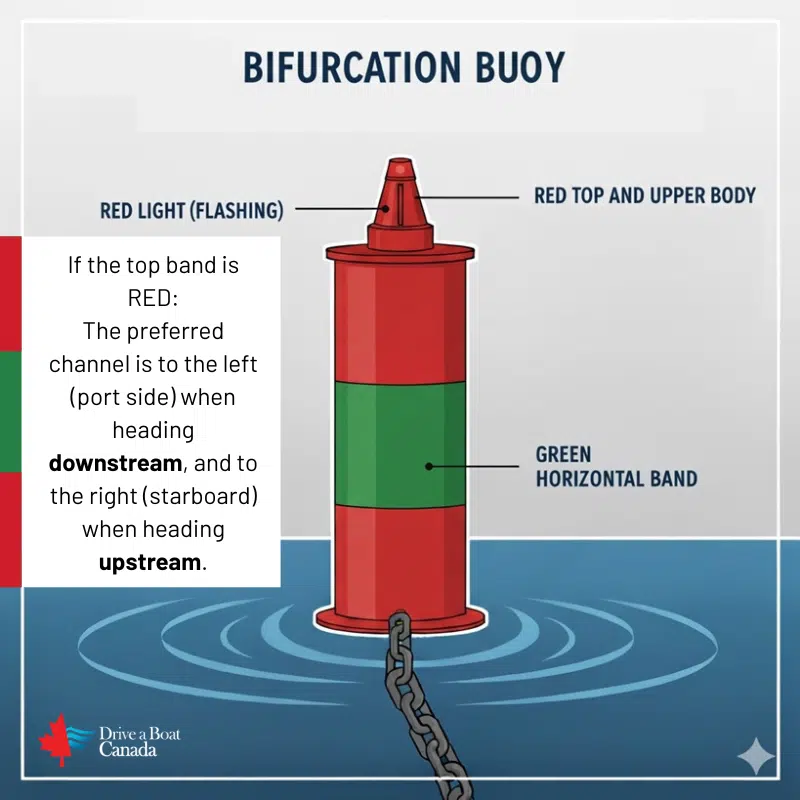
Bifurcation buoys have red and green bands. You may pass one on either side, whether you are travelling upstream or downstream.
Green top band
If the top band is green, the preferred channel is to the right (starboard side) when heading downstream, and left (port) when heading upstream.
Red top band
If the top band is red, the preferred channel is to the left (port side) when heading downstream, and to the right (starboard) when heading upstream.
Get your boating licence with Drive A Boat Canada!
We offer a comprehensive online course leading to lifetime certification. Register with Drive a Boat Canada today, and learn everything you need to know to pass the boating exam. With your boating licence (PCOC), you can take to the water legally anywhere in the country.
Frequently Asked Questions
It is generally easier to dock or anchor while facing upstream (against the current). The current acts as a “brake,” giving you more control over your speed. Drop anchor upstream of your desired position. The current will push your boat back over the anchor and stabilize it.
Both power-driven boats should clear each other by turning to starboard (right), similar to driving, so as to pass port-to-port. In narrow channels, recreational boaters should generally stay to the starboard side of the channel.
Important Note: The boat traveling downstream often has the disadvantage of the current pushing it, making stopping or maneuvering more difficult. This is why, in many waterways, courtesy is shown by yielding to the vessel heading upstream that is fighting the current. However, less maneuverable vessels (cargo ships, tugs, fishing vessels) always have priority over pleasure craft.
The common mnemonic is “Red Right Returning” (from seaward).
Sources
- Transport Canada. SAFE BOATING GUIDE. [PDF]. https://tc.canada.ca/sites/default/files/2024-03/tp_511e.pdf
- Government of Canada The Canadian Aids to Navigation System 2023. Canadian Coast Guard. https://www.ccg-gcc.gc.ca/publications/maritime-security-surete-maritime/aids-aides-navigation/index-eng.html#lateral
Latest articles

Is Your Boat a Pleasure Craft? Know the Law to Avoid Fines
A pleasure craft (whether it’s a canoe, kayak, motorboat or sailboat) is a boat that is used exclusively for recreational boating. Getting your Pleasure Craft Operator Card allows you to legally operate a pleasure craft anywhere in Canada where motorized vessels are permitted. However, it does not allow you to use your vessel for commercial Read more ›

All About Canada’s New Life Jacket Labels
Canada recently transitioned to new life jacket labels, and many boaters are wondering which life jackets they can use for recreational boating activities. You may also be asking whether you can use your old life jacket, what the icons on the new labels mean, and whether the same boating safety equipment rules still apply. Here Read more ›

Rules for Naming or Renaming a Boat in Canada
A boat’s name often reflects the entire journey that led to buying your own pleasure craft. Whether it represents a hard-earned retirement, a tribute to a loved one, or a symbol of freedom, putting that name on the hull is a special moment. In Canada, there are a few rules you need to follow for Read more ›