Home / Boating Safety Manual / Wind Warnings: Types of High Winds When Boating
10% OFF WITH CODE:
BLACKFRIDAY10
Wind levels have a major impact on boating safety. Boaters in Canada should take note of the wind warnings issued by Environment Canada and be prepared with the right boating safety equipment and navigation tools.
While there are no laws forbidding recreational boaters from taking to the water in high winds, there are plenty of good reasons to be careful, such as the high risk of capsizing, hypothermia, and drowning.
Key takeaways
- Environment Canada issues wind warnings so that recreational boaters can make smart decisions about whether to go out on the water.
- Official radio and internet sources provide reliable and up-to-date information.
- There are four types of wind warnings: strong, gale, storm and hurricane force.
- Other factors that come into play are wind fetch and wind over tide.
- If you are not sure if it is too windy to go boating, you should stay on shore and be safe.
Table of contents
- The 4 Types of Marine Wind Warnings
- 1. Strong wind warning
- 2. Gale warning
- 3. Storm warning
- 4. Hurricane force wind warning
- Reliable Data for Wind Warnings in Canada
- Additional Factors: Wind Fetch and Wind Over Tide
- Wind Fetch
- Wind Over Tide
- Frequently Asked Questions
The 4 Types of Marine Wind Warnings
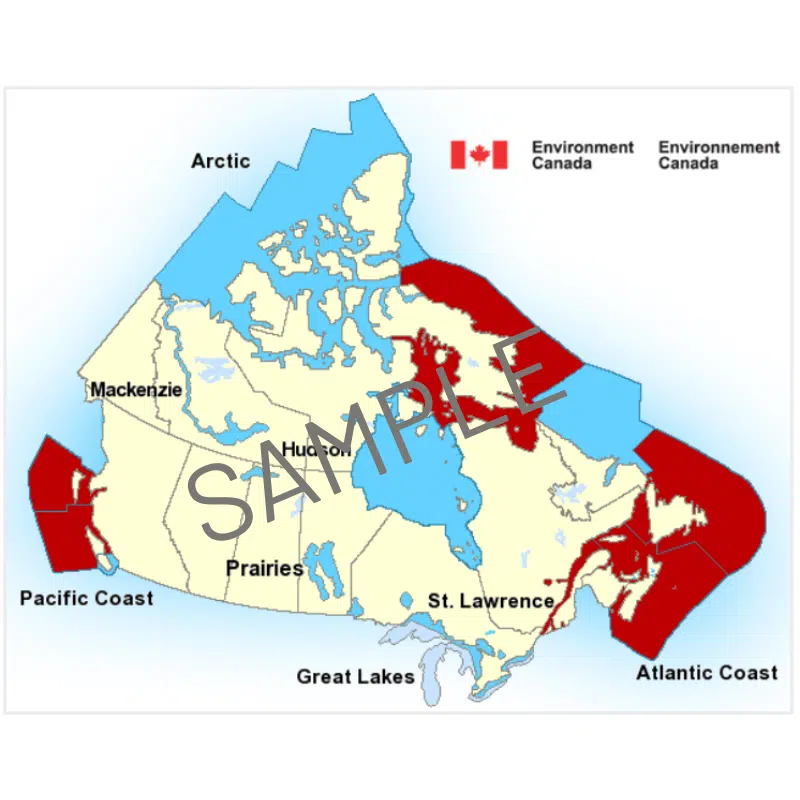
Environment Canada provides a marine forecasting service for boaters to help them make informed decisions about their safety on the water.
When conditions may prove hazardous for boaters, Environment Canada adds warnings to its forecasts.
Note: Environment Canada’s Strong Wind Warning program activity is not year-round. Boaters should check the time frame for their region to confirm the service is available where they are planning to go boating.
There are four levels of wind warnings that are used to notify boaters of high wind speeds.
| Type of Wind Warning | Wind Speed in Knots |
| Strong Wind | 20–33 knots |
| Gale Warning | 34–47 knots |
| Storm Warning | 48–63 knots |
| Hurricane Force | 64+ knots |
1. Strong wind warning
Strong wind warnings are issued for wind speeds of 20 to 33 knots (37 – 61 km/h). These warnings are intended for coastal and inland waters and are usually only used during the recreational boating season. They are not issued for marine areas where winds of this speed occur regularly.
Strong winds are challenging for small craft, so expect whitecaps.
2. Gale warning
Gale warnings are issued for wind speeds of 34 to 47 knots (62 – 87 km/h). They can be issued for any inland, coastal, or offshore area that is provided with a marine forecast.
Gale warnings are dangerous. They can cause large waves and it is recommended that you stay on shore.
3. Storm warning
Storm warnings are issued for wind speeds of 48 to 63 knots (88 – 117 km/h). They can be issued for any inland, coastal, or offshore area that is provided with a marine forecast.
A storm warning means severe conditions are expected. There is a high risk of damage or capsizing, so stay on shore.
4. Hurricane force wind warning
Hurricane force wind warnings are issued for wind speeds of 64 knots or more (118 km/h or more). It’s important to note that a hurricane force wind warning does not mean that a hurricane is imminent—it simply indicates that wind speeds will be comparable to hurricane conditions.
A hurricane force wind warning means there is extreme danger to boaters. Stay on shore.
Reliable Data for Wind Warnings in Canada
In Canada, boaters should rely on official, dedicated sources for accurate and up-to-date weather information.
These include:
- Environment Canada’s Marine Forecasts and Warnings for Canada official website. Forecasts include information about wave height, visibility, freezing spray and marine winds.
- The Continuous Marine Broadcast (CMB) service, operated by the Canadian Coast Guard. Broadcasts on channels 21B, 23B, 25B, 28B and 83B. Tune in with your VHF Marine Radio for accurate forecasts and warnings.
- Environment Canada’s Weatheradio (162.400 – 162.550 MHz). Note that not all areas are covered.
- Online at weather.gc.ca. An official source for marine forecasts.
Additional Factors: Wind Fetch and Wind Over Tide
Wind speed is important, but boaters must also remember that winds in combination with other factors can create dangerous conditions, even when the winds themselves do not necessarily pose a threat.
Wind Fetch
Wind fetch is the unobstructed distance of open water over which the wind blows in a single direction. The longer the fetch, the more energy the wind can transfer to the water’s surface, resulting in significantly larger and more powerful waves even if the wind speed remains constant.
For recreational boaters, this means a gentle breeze in a protected harbor can transform into dangerous, steep swells just a few kilometers offshore where the fetch is greater.
Example
Twenty knots of wind in a sheltered cove makes for a pleasant afternoon, but twenty knots of wind blowing across the entire length of Lake Ontario creates 2-meter swells and dangerous boating conditions.
Wind Over Tide
When wind and tide move in opposite directions, the wind’s force pushes against the moving surface of the water, causing wave energy to compress and stack up. This creates waves that are significantly taller, steeper, and closer together than the wind speed alone would suggest, often leading to unpredictable and dangerous “square waves”.
For recreational boaters, these conditions can be treacherous because the abrupt, breaking crests can easily swamp a small vessel or cause a loss of steering control.
Example
A classic and dangerous example of the wind-over-tide effect in Canada occurs at the mouth of the Fraser River in British Columbia. When a strong wind opposes the powerful outgoing current, the waves transform into dangerously tall, steep vertical walls, posing a serious threat to recreational boaters.
Get your boating licence with Drive A Boat Canada!
We offer a comprehensive online course leading to lifetime certification. Register with Drive a Boat Canada today, and learn everything you need to know to pass the boating exam. With your boating licence (PCOC), you can take to the water legally anywhere in the country.
Frequently Asked Questions
There is no single legal limit, as safety depends on your boat’s size and hull type. However, most safety experts recommend that vessels under 6 meters (20 feet) head for shore if winds approach 10–12 knots (roughly 20 km/h), especially on large lakes where waves build quickly.
This is often due to shoaling. As waves move from deep water into shallower areas near the coast, the bottom of the wave slows down while the top keeps its momentum. This causes the wave to become taller, steeper, and more likely to break, which is why the entrance to a harbor can often be the most dangerous part of a trip.
Keep an eye on the western and northern skies, as most Canadian weather systems move from West to East. Look for towering clouds (cumulonimbus), a sudden drop in temperature, or a rapid shift in wind direction. These are classic signs that a squall or front is imminent.
No. Environment Canada uses the “wind light” forecast for speeds under 12 knots, but waves can still be high depending on various factors, including leftover storm swell, wind fetch, and the effects of wind over tide. If you aren’t sure, check the wave height forecast by Environment Canada.
If you are questioning whether it’s too windy to go out, the answer is usually: stay on shore.
If you are caught in severe weather, immediately ensure everyone is wearing a lifejacket, seat passengers low and centered in the boat, and head for the nearest safe shore or shelter.
Sources
- Government of Canada Canadian marine warning program: chapter 1 Canadian Marine Warning Program. https://www.canada.ca/en/environment-climate-change/services/general-marine-weather-information/publications/canadian-warning-program/chapter-1.html
- Government of Canada. Weatheradio: find your network Environment and Natural Resources. https://www.canada.ca/en/environment-climate-change/services/weatheradio/find-your-network.html
- Government of Canada Boating safety Marine Safety. https://tc.canada.ca/en/marine-transportation/marine-safety/boating-safety
- Government of Canada Marine Forecasts and Warnings for Canada Weather Information. https://weather.gc.ca/marine/index_e.html
Latest articles

Is Your Boat a Pleasure Craft? Know the Law to Avoid Fines
A pleasure craft (whether it’s a canoe, kayak, motorboat or sailboat) is a boat that is used exclusively for recreational boating. Getting your Pleasure Craft Operator Card allows you to legally operate a pleasure craft anywhere in Canada where motorized vessels are permitted. However, it does not allow you to use your vessel for commercial Read more ›

All About Canada’s New Life Jacket Labels
Canada recently transitioned to new life jacket labels, and many boaters are wondering which life jackets they can use for recreational boating activities. You may also be asking whether you can use your old life jacket, what the icons on the new labels mean, and whether the same boating safety equipment rules still apply. Here Read more ›

Rules for Naming or Renaming a Boat in Canada
A boat’s name often reflects the entire journey that led to buying your own pleasure craft. Whether it represents a hard-earned retirement, a tribute to a loved one, or a symbol of freedom, putting that name on the hull is a special moment. In Canada, there are a few rules you need to follow for Read more ›