10% OFF WITH CODE:
BLACKFRIDAY10
All About Canada’s New Life Jacket Labels
August 27, 2026
Canada recently transitioned to new life jacket labels, and many boaters are wondering which life jackets they can use for recreational boating activities. You may also be asking whether you can use your old life jacket, what the icons on the new labels mean, and whether the same boating safety equipment rules still apply.
Here we explain how to read the new labels so you can go boating safely and obey the law in Canada.
Key Takeaways
- New life jacket labels divide PFDs into wearable and throwable categories.
- Wearable life jackets are labelled with other important information about buoyancy level, size, activity and turnability.
- Level 70 personal flotation devices (PFDs) are the most appropriate choice for common recreational boating activities. Make sure the life jacket is also the right size and appropriate for adult or child use.
- You can still wear a life jacket with an old label, as long as it is in good working condition.
- All other boating safety equipment rules still apply.
How the New Life Jackets Labels Work
In the past, Canada divided life jackets according to their Type. Now, they are considered either “throwable” or “wearable”. Wearable life jackets are further labelled with information about buoyancy level, size, activity and whether they will turn the wearer on their back if they are unconscious.
Buoyancy Levels
Life jackets are now classified by buoyancy levels. These can be hard to understand without a guide. Here’s a quick look at what they mean for practical purposes:
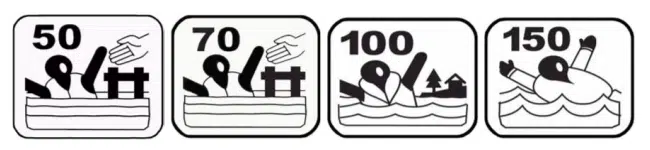
Buoyancy Level 50
These jackets are designed to be lightweight and flexible. They basically help you float and are acceptable for strong swimmers in calm waters close to shore. You have to be wearing the jacket to meet legal requirements (not just carrying it on your boat).
Level 70
These are the direct replacement for life jackets used for regular recreational boating activities. They are comfortable and effective, and can be used on inland lakes and rivers.
Level 100 or 150
These replace life jackets used in extreme conditions such as rough coastal waters.
| Buoyancy Level | Actual Buoyancy | What It’s Used For |
| Level 50 | ~50 Newtons (11 lbs of float) | For strong swimmers in calm, sheltered waters very close to shore where rescue is immediate. |
| Level 70 | ~70 Newtons (15.5 lbs of float) | Replaces standard recreational PFDs. |
| Level 100 | ~100 Newtons (22 lbs of float) | Designed for rougher or coastal waters where rescue might take some time. |
| Level 150 | ~150 Newtons (34 lbs of float) | For open, rough, or offshore waters. |
Other Important Symbols on the New Labels
The new labels show more than buoyancy to help you decide which type you need. This is important because children need extra features, such as the ability to turn the wearer on their back if unconscious. Everybody needs a life jacket that is the right size. And not all life jackets are made for all types of water sports.
Always check the following icons on the new label to make sur you are using the right life jacket:
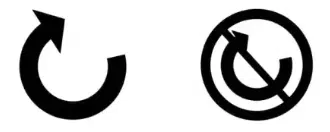
Curved circular arrow
If you see this icon, the jacket is designed to turn you face-up if you are unconscious or struggling from cold water shock or any other health issue that could prevent you from keeping your own face out of the water. Children should always wear a life jacket that can keep their head above water. If there’s a big slash through the circular arrow, the life jacket does not have this function.
Activities icons
New labels show icons for different water sports so you can tell at a glance which jacket you can use (or cannot use) for your boating activity. They show Jet Skis, whitewater paddling, water skiing, and tubing. If an activity has a circle with a line through it, you cannot use that type of jacket for that sport.

Sizes
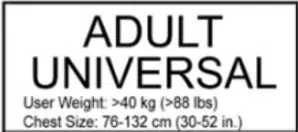
Sizes are clearly laid out with matching metric and imperial blocks (kilograms/pounds and centimeters/inches) right next to each other. Always choose the right sized life jacket or PFD for the person wearing it. You are legally obliged to have a correctly-sized life jacket on board for each person in a boat, including those participating in water activities.
Which Life Jacket Should I Use for Recreational Boating?
Level 70 personal flotation devices (PFDs) are the most appropriate choice for common recreational boating activities, including:
- Calm-water paddling
- General recreational powerboating
- High-speed towing sports like water skiing, wakeboarding, tubing and operating a PWC.
Level 100 or 150 PFDs are recommended for sailing or boating in any areas where rescue could be delayed.
Can I Still Use My Old Life Jacket?
If you own an older PFDs with a classic Type I, II, III, or IV tag, don’t worry. They remain entirely legal to use as long as they are in good condition, fit the wearer, and are approved by the USCG or Transport Canada. Both labels are currently accepted in both countries.
Remember: always test your PFD before taking to the water.
Learn About Boating Safety Equipment with Drive A Boat Canada
Personal flotation devices are a required type of boating safety equipment in Canada. You need to know what to carry on your boat and how to follow navigation laws in order to boat legally. The best way to learn is by taking a Transport Canada approved boating safety course like the one offered by Drive A Boat Canada.
It’s 100% online, and as soon as you pass the exam, you will be awarded a printable temporary boating licence (PCOC), so you can go boating right away. All operators of motorised vessels need a Pleasure Craft Operator Card; it’s the law.
Register now!