
Home / Boating Safety Manual / Port and Starboard Side: Learn the Difference
10% OFF WITH CODE:
BLACKFRIDAY10
Port and Starboard Side: Learn the Difference
Every boater needs to know the difference between port and starboard. It’s absolutely necessary for safe navigation, and for clear, immediate communication, especially during maneuvers, docking and when avoiding collisions.
It’s also key to following the rules of the road, and correctly interpreting beacons, buoys and markers.
It might take a moment to wrap your mind around the difference between port and starboard, but once you grasp these key terms, you’ll be well on your way to safely navigate Canada’s many beautiful waterways.
Key takeaways
- Port and starboard are the correct nautical terms for the left and right sides of a boat when facing forward.
- Port and starboard are used when referring to navigational aids such as beacons and buoys. Correctly interpreting these markers requires that you know the difference between port and starboard down pat.
- Port and starboard are associated with colours: red for port, green for starboard.
Table of contents
- What is the starboard side of a boat?
- What is the port side of a boat?
- Tip for remembering the difference between port and starboard
- Port and starboard lights
- Port-and starboard-hand buoys and markers
- Why you need to know the difference between port and starboard
- Bonus: origins of the terms “port” and “starboard”
- Frequently Asked Questions
What is the starboard side of a boat?
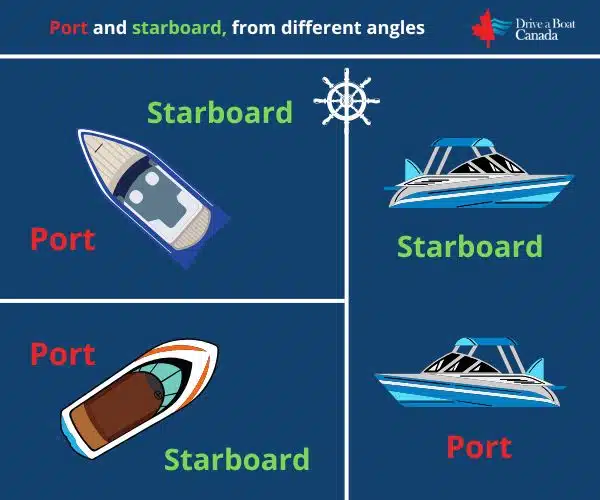
Starboard is the nautical term for the right side of a boat, when you are in the boat facing forward.
What is the port side of a boat?
Port is the nautical term for the left side of a boat, when you are in the boat facing forward.
Tip for remembering the difference between port and starboard
Here’s a quick trick to remember port and starboard: both “port” and “left” have four letters. So, if “port” means “left,” then “starboard” must mean “right.”
Port and starboard lights
Lights are vital to nighttime navigation, and may be the only indication of a vessel’s direction or an important marker when it is dark or in poor visibility (such as fog).
Port and starboard lights on a boat
A red light indicates the port side of a vessel.
A green light indicates the starboard side of a vessel.
Port-and starboard-hand buoys and markers
Buoys and beacons in Canadian waters also follow a colour system to indicate port or starboard (the IALA Region B system). This consistent colour scheme helps mariners navigate safely through channels and waterways in various weather conditions.
Port and starboard lights on buoys
The colour of the light on a buoy typically matches the colour of the buoy itself. Red buoys have red lights, while green buoys have green lights.
Starboard-hand buoys
A starboard-hand buoy is coloured red and has an even number. You must keep it on the starboard (right) side of your boat when heading upstream or entering a harbour. In the context of maritime navigation, starboard buoys mark the right side of a channel when approaching from seaward or moving towards the headwaters of a river.
Port-hand buoys
In contrast, port-hand buoys, which mark the left side of the channel, are coloured green and have odd numbers. You must keep a green buoy on the port (left) side of your boat when heading upstream. This colour-coding system is part of the IALA (International Association of Marine Aids to Navigation and Lighthouse Authorities) Region B buoyage system, which Canada follows.
It’s important to note that “upstream” in this context generally refers to the direction from the sea towards the headwaters of a river or when entering a harbour. This system of red-right-returning (keeping red buoys on your right when returning from sea) is a key principle for safe navigation in Canadian waters.
Why you need to know the difference between port and starboard
There are many reasons why you should learn to use the terms “port” and “starboard” instead of just “left” and “right”.
Port and starboard always refer to the same sides of the boat
These terms refer to fixed locations on a vessel, meaning they never change. The terms “left” and “right”, on the other hand, will not always refer to the same part of the boat, depending on which way you are facing.
Example: The “port” side of a boat will be on the left if you are facing forward, and on the right if you are facing the stern.
This can get quite confusing, and even be dangerous when following navigational guidelines, passing other vessels, or in an emergency situation.
Port and starboard help avoid collisions
You need to know port and starboard to make the right decision when crossing another boat or meeting another vessel head-on.
- In crossing situations, the vessel that has the other vessel approaching from its starboard (right) side is the give-way vessel and must maneuver to avoid a collision.
- When two vessels meet head-on, both should alter course to starboard (right) to pass port-side to port-side (red light to red light).
Port and starboard are the correct nautical terms
Port and starboard are the official, correct terms to use to describe the sides of your boat, as set out by the International Regulations for Preventing Collisions at Sea. It is obligatory to use the correct terms during any legal proceedings related to your boating activities.
Bonus: origins of the terms “port” and “starboard”
The term “starboard” originated in the early days of boating, before ships had rudders on their centerlines. Ships were steered using a steering oar, which was typically placed on the right side of the stern because most sailors were right-handed. This steering side became known as “steorbord” in Old English, combining the words for “steer” and “board” (side of a boat). This eventually evolved into “starboard” to refer to the right side of a vessel.
Originally, the left side of a ship was called “larboard”, likely derived from “ladebord” meaning “loading side”. However, “larboard” sounded very similar to “starboard”, which could cause confusion, especially in bad weather or emergencies. To avoid this, the term “port” was adopted in the 19th century to refer to the left side, probably due to the practice of docking ships on their left sides.
Get your boating licence with Drive A Boat Canada!
We offer a comprehensive online course leading to lifetime certification. Register with Drive a Boat Canada today, and learn everything you need to know to pass the boating exam. With your boating licence (PCOC), you can take to the water legally anywhere in the country.
Frequently Asked Questions
“Left” and “right” change depending on the direction a person is facing. Port and Starboard are fixed, unambiguous references that refer to the sides of the vessel itself, regardless of where a person is standing or facing.
Sources
- Government of Canada The Canadian Aids to Navigation System 2023. Canadian Coast Guard. https://www.ccg-gcc.gc.ca/publications/maritime-security-surete-maritime/aids-aides-navigation/index-eng.html
- Transport Canada. SAFE BOATING GUIDE. [PDF]. https://tc.canada.ca/sites/default/files/2024-03/tp_511e.pdf
-
Latest articles

Is Your Boat a Pleasure Craft? Know the Law to Avoid Fines
A pleasure craft (whether it’s a canoe, kayak, motorboat or sailboat) is a boat that is used exclusively for recreational boating. Getting your Pleasure Craft Operator Card allows you to legally operate a pleasure craft anywhere in Canada where motorized vessels are permitted. However, it does not allow you to use your vessel for commercial Read more ›

All About Canada’s New Life Jacket Labels
Canada recently transitioned to new life jacket labels, and many boaters are wondering which life jackets they can use for recreational boating activities. You may also be asking whether you can use your old life jacket, what the icons on the new labels mean, and whether the same boating safety equipment rules still apply. Here Read more ›

Rules for Naming or Renaming a Boat in Canada
A boat’s name often reflects the entire journey that led to buying your own pleasure craft. Whether it represents a hard-earned retirement, a tribute to a loved one, or a symbol of freedom, putting that name on the hull is a special moment. In Canada, there are a few rules you need to follow for Read more ›